How Artificial Intelligence, IoT, Digital Twins, Intelligent Surveillance and Emerging Technologies Are Redefining the Cities of Tomorrow
Introduction: The Smart City Has Entered a New Era
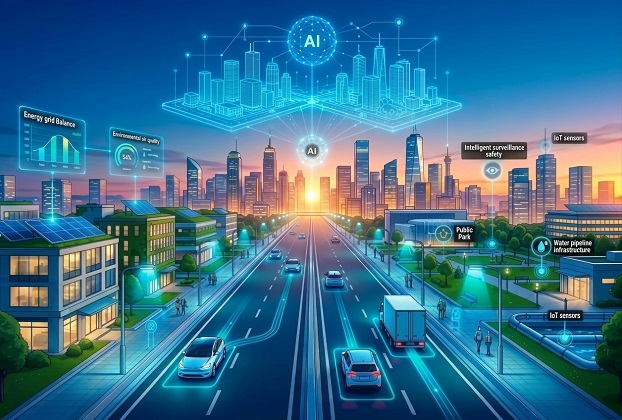
Imagine a city that can anticipate a traffic congestion problem before vehicles begin piling up. A city that can detect a water leak beneath a road, identify the affected section of the supply network, estimate the amount of water being wasted and dispatch a maintenance team before the problem becomes a major disruption.
Imagine walking through a public park late at night, knowing that an intelligent surveillance network is continuously monitoring public spaces, identifying potentially dangerous situations and enabling emergency responders to reach an incident quickly. Imagine electricity networks that automatically balance demand, buildings that optimize their energy consumption, public transport that adjusts its services according to actual passenger demand, and municipal authorities that can simulate the consequences of an urban-development decision before approving it.
Now take this vision further.
Imagine that all these systems are not operating independently but are communicating through an integrated technological ecosystem. Artificial intelligence is analyzing information from thousands or millions of sources, digital twins are representing the physical city in virtual environments, and intelligent software agents are coordinating activities across different municipal departments.
This is no longer merely a science-fiction depiction of an imaginary futuristic metropolis. Important elements of this vision are already being implemented around the world. Others are being tested through pilot projects, while some remain under development and are expected to mature over the coming years.
The concept of a smart city has therefore entered a new phase.
For many years, smart-city development was primarily associated with connecting physical objects to the internet, collecting information through sensors, automating selected services and making municipal infrastructure more efficient. These capabilities remain essential, but the arrival of increasingly sophisticated artificial intelligence, generative AI, autonomous systems, digital twins, advanced connectivity and intelligent analytics has significantly expanded what cities can potentially achieve.
The distinction is becoming increasingly important.
A connected city can collect information about its environment. A smart city can process that information and make informed decisions. An emerging cognitive city can combine information from multiple systems, recognize patterns, anticipate future situations, simulate alternative outcomes and coordinate appropriate responses.
The ultimate objective is not to replace human decision-makers with machines or to automate every aspect of urban life. It is to build an environment in which technology helps governments use resources more intelligently, deliver services more effectively, protect citizens, reduce environmental damage and improve the overall quality of life.
This transformation is becoming increasingly urgent. According to the United Nations’ World Urbanization Prospects 2025, cities are home to approximately 45% of the world’s population of 8.2 billion. The UN also projects that two-thirds of global population growth through 2050 will occur in cities. UN-Habitat’s 2025 Future Cities Advisory Outlook discusses an additional 2.3 billion urban residents by 2050 as a major challenge for housing, transportation, energy and municipal services.
The question is no longer whether cities need to become smarter. The real question is how intelligently, sustainably and responsibly they can evolve.
1. From IoT-Based Smart Cities to Cognitive Urban Ecosystems
In December 2019, I published an article on ITPrecinct.com titled IoT-Based Smart Cities’ Vision. It explored how the Internet of Things, distributed computing, high-speed connectivity, cloud and edge computing, artificial intelligence and interconnected civic services could collectively transform urban environments.
The article discussed the role of connected devices, smart homes, autonomous transportation, intelligent street lights, waste management and smart factories. It also examined architectural concepts such as Service-Oriented Architecture (SOA), Event-Driven Architecture (EDA), information layers, infrastructure layers, service layers and management layers.
The fundamental vision remains valid.
However, the technological landscape has changed considerably since then. Artificial intelligence has become much more capable and accessible, cloud platforms have matured, edge and fog computing has gained practical importance, computer vision has advanced, and digital twins have evolved from relatively specialized engineering tools into increasingly important instruments for urban planning and operations.
The following progression helps explain this transformation.
First generation: Connected cities
The initial emphasis was on connecting devices, collecting data and making physical infrastructure remotely accessible.
Examples included smart electricity meters, connected streetlights, environmental sensors, vehicle tracking systems and automated waste containers.
Second generation: Data-driven smart cities
The emphasis shifted towards integrating information from different sources, using centralized platforms, cloud computing, analytics and interconnected municipal applications.
Instead of operating individual smart systems independently, authorities could begin obtaining a consolidated view of urban activities.
Third generation: AI-powered predictive cities
Artificial intelligence introduced the ability to identify patterns, forecast demand, detect anomalies and recommend decisions.
For example, a traffic-management system could learn from historical and current traffic conditions to anticipate congestion and adjust signal timings.
Emerging fourth generation: Cognitive and increasingly autonomous cities
The next development involves integrating AI agents, digital twins, intelligent infrastructure and automated workflows into citywide operational environments.
Such systems could identify an emerging problem, evaluate possible responses, coordinate the relevant departments and execute approved actions within predefined boundaries.
This fourth generation is an emerging direction, not a universally achieved state. Most cities will progress unevenly, with some services becoming highly automated while others continue to depend on conventional infrastructure and human-operated processes.
Nevertheless, it represents a compelling direction for the future.
2. Artificial Intelligence: The Brain of the Future City
If IoT provides the sensory infrastructure of a smart city, artificial intelligence increasingly provides its analytical and decision-making capabilities.
Traditional information systems generally operate according to predefined rules. They receive information, execute programmed instructions and produce predictable outcomes.
AI introduces additional capabilities. It can identify complex patterns, process unstructured information, recognize objects in images, understand natural language, generate summaries, forecast changing conditions and assist decision-makers in situations involving large quantities of information.
Several categories of AI are particularly relevant to urban environments.
2.1 Machine Learning and Predictive Analytics
Machine learning systems can analyze historical and real-time information to identify patterns and predict future events.
Consider an urban electricity network. By analyzing weather conditions, historical consumption, commercial activity and real-time smart-meter readings, an AI system can forecast electricity demand.
This information can help utilities prepare for peak consumption periods, balance available generation and reduce the likelihood of supply disruptions.
Similar techniques can be applied to:
- Predicting traffic congestion.
- Forecasting water consumption.
- Identifying electricity distribution faults.
- Predicting equipment failures.
- Estimating public transport demand.
- Identifying areas requiring additional municipal services.
- Forecasting flooding and environmental hazards.
Predictive analytics is especially valuable because preventing a problem is frequently less expensive and more effective than responding after it has occurred.
2.2 Generative AI and Conversational Municipal Services
Generative AI makes it possible for citizens to interact with government services through natural language.
Instead of navigating complicated websites or visiting several municipal departments, a resident could communicate with a virtual municipal assistant.
For example:
“I want to report a broken streetlight outside my house.”
The assistant could identify the location, register the complaint, retrieve the relevant infrastructure record, assign the matter to the responsible department and provide a tracking reference.
Another citizen might ask:
“Why has my water supply been interrupted, and when is it expected to resume?”
The assistant could retrieve the latest service information and provide an understandable response.
Generative AI can also assist government employees in reviewing applications, summarizing documents, translating information, drafting responses and retrieving relevant regulations.
These systems must, however, use verified government information and appropriate access controls. A convincing AI-generated answer is not necessarily an accurate answer.
2.3 Agentic AI: Moving Beyond Recommendations
One of the more significant emerging developments is agentic AI.
Traditional AI applications frequently provide predictions, recommendations or generated content. Agentic systems can go further by executing sequences of actions through authorized tools and workflows.
Consider a hypothetical incident involving a major water leak.
An integrated system might:
- Receive abnormal pressure readings from water-network sensors.
- Identify the likely location of the damaged pipeline.
- Consult geographic infrastructure records.
- Estimate the affected distribution area.
- Identify hospitals and other critical facilities in that area.
- Recommend isolation of the affected section.
- Notify the water utility and municipal maintenance team.
- Update the relevant operational dashboard.
- Inform affected residents through approved communication channels.
Some of these steps could be automated, while consequential decisions would remain subject to human approval.
The important distinction is that AI is no longer simply producing information for an employee to interpret. It is increasingly becoming part of the operational workflow.
2.4 Computer Vision and Intelligent Video Analytics
Computer vision enables machines to extract information from images and video.
In smart cities, this technology can be used for traffic monitoring, pedestrian counting, road-condition assessment, public-space monitoring, waste detection and public safety.
For example, an AI-powered camera system may detect a vehicle stopped in a dangerous location, identify a traffic accident, recognize an obstruction on a road or alert operators to unusually dense crowd movement.
This technology is particularly important for Safe City infrastructure, which deserves substantial attention in its own right.
2.5 Human Supervision Remains Essential
AI should not become an unquestionable authority over citizens.
Its recommendations can be inaccurate, its training data can contain biases, and automated systems can sometimes misinterpret unusual circumstances.
A responsible smart city must therefore establish clear boundaries between automated actions and decisions requiring human judgment.
The objective should be intelligent assistance and controlled automation, not blind dependence on algorithms.
3. IoT and the Internet of Everything: The City’s Sensory Infrastructure
The Internet of Things remains one of the most fundamental building blocks of a smart city.
IoT refers to physical objects equipped with sensors, software, communication capabilities and, in many cases, actuators that allow them to interact with their environment.
These objects may include electricity meters, water meters, traffic sensors, cameras, environmental monitoring devices, industrial equipment, vehicles, streetlights and building-management systems.
The next evolution is sometimes described as the Internet of Everything, emphasizing the integration of people, processes, data and connected objects.
3.1 Environmental and Infrastructure Sensors
Sensors installed throughout an urban environment can continuously collect information about:
- Temperature and humidity.
- Air quality and particulate pollution.
- Noise levels.
- Water pressure and flow.
- Soil moisture.
- Electricity consumption.
- Structural vibrations.
- Traffic volume and speed.
- Floodwater levels.
- Waste-container capacity.
This information can be transmitted to edge devices or central platforms for processing.
For example, water-level sensors installed near drainage channels can provide early warnings when water begins accumulating during heavy rainfall.
Similarly, air-quality sensors can identify pollution hotspots and help authorities investigate their sources.
3.2 Connected Infrastructure and Smart Assets
Infrastructure assets can also become digitally identifiable and manageable.
Bridges, streetlights, pumps, electrical transformers, traffic signals, public buildings and utility networks can be represented in digital asset-management systems.
By combining asset records with sensor readings, maintenance histories and AI-based analytics, authorities can identify equipment that requires inspection or replacement.
This is particularly valuable in cities where maintenance is traditionally reactive and infrastructure failures are frequently discovered only after citizens report them.
3.3 The Importance of Interoperability
A city may deploy thousands of sensors from different manufacturers and use several software platforms to manage them.
If these systems cannot exchange information, the city effectively creates disconnected technological islands.
Interoperability therefore becomes essential.
Open communication standards, documented APIs, common data models, consistent geographic identifiers and well-designed integration layers allow information to move between otherwise independent systems.
A genuinely intelligent city must be built around integration rather than merely accumulating connected devices.
4. Connectivity: 5G, 6G and the Networks of Tomorrow
A citywide digital ecosystem requires reliable communication infrastructure.
The ability to collect and analyze information is of limited value if devices cannot communicate with the systems responsible for processing that information.
4.1 5G: An Important Foundation
5G provides capabilities that can support many smart-city applications.
These include high data rates, improved network capacity, lower latency in suitable deployments and support for large numbers of connected devices.
Potential applications include:
- High-resolution surveillance video.
- Connected vehicles.
- Smart traffic infrastructure.
- Industrial automation.
- Remote infrastructure monitoring.
- Public-safety communications.
- Augmented and virtual reality applications.
Private 5G networks can also be deployed for specific environments, such as industrial districts, ports, airports and critical infrastructure facilities.
However, 5G should not be treated as a mandatory prerequisite for every smart-city application. Many sensors operate effectively using technologies such as NB-IoT, LTE-M, LoRaWAN, Wi-Fi or conventional cellular networks.
The correct communication technology depends on the application, coverage requirements, power consumption, data volume, latency and cost.
4.2 6G: The Next Connectivity Frontier
There is considerable interest in 6G, often referred to by the International Telecommunication Union as IMT-2030.
It is important to distinguish current research and standardization activities from commercial availability.
As of November 2026, 6G is not an established, commercially deployed mainstream mobile-network generation.
The ITU has progressed its IMT-2030 framework and technical requirements. In March 2026, it reported that mobile communications experts had agreed on draft performance requirements covering six proposed usage scenarios:
- Immersive communication.
- Hyper-reliable and low-latency communication.
- Massive communication.
- Ubiquitous connectivity.
- AI and communication.
- Integrated sensing and communication.
These developments provide a framework for evaluating future 6G technologies. Commercial deployment is generally anticipated around 2030, although actual availability will depend on standards, spectrum, infrastructure investment and device ecosystems.
For smart cities, the most interesting possibilities include AI-native network management, integrated sensing and communications, advanced positioning, ubiquitous connectivity and improved support for highly interactive applications.
Integrated sensing and communication is particularly interesting because networks may eventually provide both communication and environmental sensing capabilities.
Nevertheless, cities should not postpone practical digital transformation while waiting for 6G. Existing 4G, 5G, fibre, Wi-Fi and low-power IoT networks can already support substantial improvements.
5. Cloud, Edge and Distributed Computing
The enormous quantity of information generated by a connected city creates substantial processing and storage requirements.
Cloud computing provides scalable infrastructure for storing information, executing applications, analyzing data and coordinating services across departments.
However, sending every sensor reading and every video frame to a distant data centre is neither necessary nor always practical.
This is where edge computing becomes important.
5.1 Edge Intelligence
Edge computing moves processing closer to the devices generating information.
For example, a surveillance camera equipped with suitable processing capabilities can identify a possible traffic accident locally and transmit an event notification rather than continuously transmitting every frame to a central facility for analysis.
Similarly, a traffic controller can process local sensor readings and adjust signals without depending on a remote server for every decision.
This can reduce latency, bandwidth consumption and unnecessary data transfers.
5.2 Hybrid Cloud and Distributed Architecture
A practical smart-city architecture will generally combine:
- Edge devices for immediate local processing.
- Local data centres for sensitive or operationally critical applications.
- Private and public cloud platforms for scalable computing.
- Centralized data platforms for cross-departmental analysis.
- Distributed systems for resilience and continuity.
Critical services should not become unavailable simply because a cloud connection is interrupted.
Electricity distribution, emergency communication, traffic control and other essential functions require carefully designed fallback mechanisms.
5.3 Data Sovereignty and Infrastructure Ownership
Cities also need to determine where their information is stored, who can access it and which organizations are responsible for protecting it.
Government records, public-safety video, citizen identities and infrastructure information can be extremely sensitive.
Data sovereignty, contractual controls, encryption, access management and secure backup arrangements should therefore be addressed at the architectural level.
6. Digital Twins: Building a Virtual Representation of the Physical City
Among the most interesting developments in contemporary smart-city technology is the digital twin.
A digital twin is a digital representation of a physical object, process or environment that is connected to relevant information about its real-world counterpart.
In a smart-city context, digital twins can represent buildings, roads, bridges, transportation networks, utility systems, public spaces or entire urban areas.
Unlike an ordinary 3D model, a sophisticated digital twin can incorporate changing information from sensors, databases, geographic information systems and operational platforms.
6.1 Understanding How an Urban Digital Twin Works
Imagine a virtual representation of a city containing its roads, buildings, utility networks, drainage systems, public transport routes and other infrastructure.
The model is connected to relevant operational information.
When a road is closed, the information can be reflected in the digital environment. When a water network reports abnormal pressure, the corresponding infrastructure can be identified geographically. When a new building is proposed, planners can assess its potential impact on surrounding roads, utilities and services.
The digital twin becomes an analytical environment for understanding the physical city.
6.2 Urban Planning and Simulation
Digital twins can help authorities evaluate alternative development scenarios.
For example, before approving a new commercial district, planners could simulate:
- Expected traffic generation.
- Parking requirements.
- Electricity demand.
- Water consumption.
- Wastewater requirements.
- Drainage capacity.
- Effects on nearby public transport.
- Potential environmental consequences.
This allows decisions to be informed by simulated outcomes rather than relying exclusively on static plans and assumptions.
6.3 Flooding and Disaster Management
Consider a city exposed to seasonal flooding.
A digital twin could combine elevation models, drainage-network information, rainfall forecasts, river levels and sensor readings to simulate possible flooding scenarios.
Authorities could identify vulnerable locations, evaluate evacuation routes, estimate the impact on critical facilities and prioritize emergency resources.
The usefulness of such a system depends on the accuracy and freshness of its underlying data. A visually impressive 3D model without reliable operational information is not a meaningful digital twin.
6.4 Real-World Example: Seoul
Seoul Metropolitan Government’s Virtual Seoul, also known as S-Map, provides an interesting example.
According to the city’s published information, its digital twin represents the entire Seoul area of approximately 605.23 square kilometres in 3D.
The platform includes around 600,000 structures and facilities in its ground dataset, together with spatial and administrative information.
It supports 3D analysis, policy evaluation, simulation and the integration of urban information within a virtual environment.
This demonstrates that city-scale digital twins are no longer merely theoretical research projects.
6.5 The Emerging AI-Enabled Citiverse
The term Citiverse is increasingly being used to describe the convergence of digital twins, artificial intelligence, spatial computing and immersive technologies in urban environments.
The International Telecommunication Union published a series of AI-Enabled Citiverse reports in 2026, including practical use cases covering:
- Urban planning and infrastructure.
- City administration and public participation.
- Economic development, education and tourism.
- Transport and mobility.
- Public safety, health and disaster resilience.
Its use-case taxonomy identifies approximately 50 applications and distinguishes mature applications, pilot-stage developments and more conceptual possibilities.
This distinction is useful because it helps policymakers avoid treating every emerging technology as equally ready for deployment.
The Citiverse concept could eventually provide a shared virtual environment through which authorities, planners, businesses and citizens interact with a digitally represented city.
7. AI-Powered Safe Cities: Intelligent Surveillance and Public Safety
A city cannot truly be considered smart if its citizens do not feel safe.
Transportation efficiency, digital governance, smart buildings and advanced utilities are important achievements. However, the ability to protect residents, prevent crime and respond quickly to emergencies is equally fundamental.
This is why intelligent public safety should be regarded as one of the major pillars of next-generation smart-city architecture.
The Safe City concept is not simply about installing surveillance cameras at public locations. It involves building an integrated public-safety ecosystem in which cameras, sensors, communication networks, AI-powered analytics, emergency services and law-enforcement systems work together.
7.1 Citywide Intelligent Surveillance Networks
A modern Safe City can deploy strategically positioned surveillance cameras across:
- Major roads and intersections.
- Public parks and recreational areas.
- Commercial districts.
- Public transport stations.
- Government buildings.
- Airports and transport terminals.
- Public squares and pedestrian areas.
- Sensitive infrastructure facilities.
- Identified crime hotspots.
These cameras can provide continuous monitoring and transmit relevant information to integrated command and control centres.
Modern systems can incorporate fixed cameras, pan-tilt-zoom cameras, high-resolution cameras, thermal imaging and specialized traffic cameras.
The objective is not necessarily to record everything centrally at maximum resolution. Intelligent processing can help prioritize relevant events and make effective use of network and storage resources.
7.2 AI-Powered Detection of Suspicious and Dangerous Activities
One of the most valuable applications of computer vision is automated event detection.
AI-powered video analytics can be configured to identify situations that require human attention.
Examples include:
- Physical altercations and possible violent incidents.
- A person collapsing in a public area.
- Vehicles travelling in prohibited directions.
- Vehicles stopping in dangerous locations.
- Unusual crowd accumulation.
- Objects abandoned in sensitive areas.
- Unauthorized entry into restricted facilities.
- Traffic accidents and road obstructions.
- Possible vandalism.
- Fires, smoke and other visible hazards.
The system can generate an alert containing the camera location, timestamp, relevant video segment and event classification.
An operator can then verify the incident and initiate the appropriate response.
The distinction between detection and proof is important. AI can identify potentially suspicious behaviour, but an algorithmic alert must not automatically be treated as evidence that a crime has occurred.
7.3 Automatic Number Plate Recognition
Automatic Number Plate Recognition (ANPR), also known as Automatic License Plate Recognition, can identify vehicle registration numbers from camera images.
This technology can assist authorities in:
- Identifying vehicles reported stolen.
- Locating vehicles associated with verified investigations.
- Detecting vehicles violating designated restrictions.
- Monitoring traffic entering and leaving selected areas.
- Supporting electronic traffic enforcement.
- Identifying vehicles of interest in authorized investigations.
When integrated with appropriate databases, ANPR can significantly improve the speed of vehicle-related investigations.
However, database accuracy, legal authority, access restrictions and auditability are essential.
7.4 Facial Recognition and Biometric Identification
Facial recognition is another emerging capability, but it requires particularly careful treatment.
Where legally authorized and proportionate, biometric identification may assist in specific investigations or controlled security environments.
It should not be assumed that every camera in every public space should continuously identify every individual.
Facial recognition systems can produce false matches, and their accuracy can vary according to image quality, lighting, demographic characteristics and other conditions.
A responsible Safe City programme should therefore establish strict authorization requirements, independent oversight, human verification, audit trails and mechanisms for challenging incorrect identifications.
Public safety should not come at the expense of fundamental rights.
7.5 Gunshot and Unusual-Sound Detection
Not every emergency can be detected visually.
Acoustic sensors can potentially identify gunshot-like sounds, explosions, distress signals, vehicle collisions and other unusual acoustic events.
A network of such devices can help direct emergency responders towards an incident even when no caller has reported it.
However, acoustic detection is probabilistic. Fireworks, construction noise and other environmental sounds can generate false alerts. Verification is therefore essential.
7.6 Intelligent Crowd Management
Large gatherings, religious events, public demonstrations, sporting events and commercial activities can create crowd-management challenges.
AI-based analytics can help estimate crowd density, identify bottlenecks, detect dangerous congestion and alert operators when movement patterns indicate a potential hazard.
This capability can assist authorities in managing evacuation routes, opening additional access points and deploying emergency personnel.
The objective should be public safety and crowd welfare, not indiscriminate monitoring of lawful assembly or the suppression of legitimate civic activity.
7.7 Integrated Emergency Response
Detection alone does not make a city safe.
The real value comes from integrating surveillance and sensor networks with the organizations responsible for responding to incidents.
A modern Safe City command centre could coordinate:
- Police patrol units.
- Ambulances.
- Fire and rescue services.
- Traffic police.
- Disaster-management authorities.
- Emergency medical facilities.
- Municipal maintenance teams.
Consider a hypothetical road accident.
An AI system identifies a collision through a surveillance camera. It generates an alert containing the location and available video evidence. The control centre verifies the incident, identifies the nearest available ambulance and notifies the relevant traffic personnel.
The hospital can receive an advance notification, while traffic management systems can redirect vehicles away from the affected road.
This is a much more meaningful application of intelligent surveillance than simply recording an incident for investigation several hours later.
7.8 Integrated Safe City Command and Control Centres
The operational heart of such a system is an integrated command and control centre.
Its capabilities may include:
- A geographic dashboard displaying cameras and incidents.
- Real-time video monitoring.
- AI-generated event alerts.
- Vehicle tracking and ANPR results.
- Emergency dispatch.
- Incident prioritization.
- Communication with field personnel.
- Historical incident analysis.
- Evidence management.
- Performance and response-time reporting.
The command centre should not be viewed as merely a room containing hundreds of screens. It is an operational coordination environment supported by reliable technology, trained personnel, standard operating procedures and clear accountability.
7.9 Real-World Progress: India
India provides a substantial example of Safe City and integrated smart-city infrastructure.
Under its Smart Cities Mission, 100 cities established Integrated Command and Control Centres.
According to India’s Ministry of Housing and Urban Affairs, as reported in August 2026, more than 83,000 CCTV surveillance cameras had been installed under the programme.
The same government update reported:
- 100 Integrated Command and Control Centres established.
- More than 1,700 kilometres of smart, accessible roads constructed.
- More than 17,000 kilometres of water-supply networks monitored through SCADA.
- More than 1,300 public-space projects completed.
- 7,790 of 8,064 reported projects completed as of 31 March 2026.
These figures demonstrate the scale at which connected urban infrastructure is being deployed.
They do not, by themselves, prove a particular reduction in crime or establish that every city has achieved an equally effective integrated operating environment. Infrastructure deployment and measurable public-safety outcomes must be evaluated separately.
7.10 Real-World Progress: Pakistan
Pakistan is also developing Safe City infrastructure.
The Punjab Safe Cities Authority operates an integrated command, control and communication programme. Its published programme description identifies surveillance coverage, emergency response, traffic management, electronic evidence collection and coordination between police departments as important objectives.
Islamabad is also expanding its Safe City infrastructure, with official updates in July 2026 discussing AI-based surveillance, smart policing and improved traffic management.
Karachi provides an especially relevant example.
According to the Sindh Safe Cities Authority’s published project information, Phase I of the Karachi Safe City Project includes approximately 1,200 cameras installed across 300 pole sites, covering the Red Zone and Airport Corridor. The project incorporates technologies including ANPR, facial recognition, intelligent traffic systems and pan-tilt-zoom cameras.
The Sindh government also announced the proposed scope of Phase II in October 2025. In April 2026, Dawn reported approval of a Phase II project worth approximately Rs9.98 billion, involving more than 2,300 additional smart cameras.
These developments demonstrate that intelligent surveillance is becoming part of Pakistan’s urban-development agenda.
However, the existence of a camera network is only the beginning. Effective connectivity, operational staffing, database integration, maintenance, response procedures and independently measurable outcomes will determine its actual value.
7.11 Privacy, Accountability and Responsible Surveillance
An intelligent Safe City must protect citizens without creating an environment of unrestricted surveillance.
The following safeguards should be integral to its design:
- Clear legal authority and defined purposes for surveillance.
- Proportionate camera placement and monitoring.
- Restricted access to live feeds and recorded footage.
- Strong encryption and secure authentication.
- Defined retention periods for recordings.
- Audit trails for access and data retrieval.
- Independent oversight and complaint mechanisms.
- Human verification of consequential AI alerts.
- Strict controls over biometric identification.
- Protection against unauthorized disclosure and misuse.
A city should measure its Safe City programme not simply by the number of cameras installed, but by its ability to improve emergency response, reduce harm, protect evidence, increase public confidence and respect citizens’ rights.
A truly safe city is one in which technology helps prevent harm, emergency services respond effectively and law-abiding citizens can move freely with confidence.
8. Intelligent Transportation and Autonomous Mobility
Transportation is one of the most visible areas in which smart-city technologies can make an immediate difference.
Traffic congestion wastes time, consumes fuel, increases pollution and reduces economic productivity.
Conventional traffic-management systems often rely on fixed signal timings, manual monitoring and relatively limited information about actual traffic conditions.
An intelligent transportation system can combine cameras, road sensors, vehicle information, GPS data, navigation platforms and AI-based analytics to manage traffic dynamically.
8.1 Adaptive Traffic Signal Management
AI-based traffic systems can analyze vehicle volumes and adjust signal timings according to changing conditions.
For example, an intersection with a large queue of vehicles may receive a longer green phase, while another direction with little traffic may receive less time.
Such systems can also prioritize emergency vehicles and coordinate signals along major routes.
The objective is to improve overall traffic flow rather than simply increase vehicle speeds on individual roads.
8.2 Intelligent Public Transportation
Public transportation can benefit from real-time passenger information, predictive demand analysis, automated fleet monitoring and optimized scheduling.
An intelligent transport platform could analyze passenger volumes at different times of the day and recommend adjustments to bus frequency or route capacity.
Citizens could receive reliable information about arrivals, delays, alternative routes and service disruptions.
8.3 Connected Vehicles and V2X
Vehicle-to-Everything communication enables vehicles to exchange information with other vehicles, infrastructure and network services.
Potential applications include:
- Collision warnings.
- Traffic signal information.
- Road hazard notifications.
- Emergency vehicle alerts.
- Cooperative driving.
- Intelligent intersection management.
The technology requires suitable communication standards, vehicle support and infrastructure deployment.
8.4 Autonomous Vehicles
Autonomous driving technology continues to advance, but its maturity varies considerably by vehicle type, geography and operating conditions.
Some commercial services already operate with driverless vehicles in defined locations and under controlled operational conditions.
However, widespread autonomous mobility in complex urban environments remains a more difficult challenge.
Road quality, weather, unpredictable pedestrian behaviour, construction activities, traffic regulations and emergency situations all influence the reliability of autonomous systems.
Smart cities should therefore plan for gradual integration rather than assume that all vehicles will become autonomous within a short period.
8.5 Smart Parking and Urban Mobility
Smart parking systems can identify available spaces, guide motorists towards them and support digital payments.
This can reduce unnecessary vehicle circulation and improve the utilization of existing parking facilities.
Integration with public transport, bicycle-sharing systems, pedestrian infrastructure and electric-vehicle charging can create a more comprehensive urban mobility ecosystem.
9. Smart Energy and Intelligent Power Grids
Electricity is the foundation of modern urban life.
Hospitals, industries, residential buildings, transportation systems, communication networks and municipal infrastructure all depend on reliable power.
Unfortunately, conventional electricity networks frequently face challenges involving demand fluctuations, distribution losses, equipment failures and inadequate visibility into consumption patterns.
Smart grids introduce digital monitoring, two-way communication, automated control and advanced analytics into electricity distribution.
9.1 Smart Metering
Smart electricity meters can provide detailed consumption information and reduce dependence on manual meter reading.
Consumers can monitor their usage, while utilities can analyze demand patterns and identify abnormal consumption.
This can support more accurate billing, demand management and operational planning.
9.2 AI-Based Load Forecasting
AI can analyze historical consumption, weather forecasts, population activity and other variables to estimate future electricity demand.
Utilities can use these forecasts to plan generation, manage available capacity and reduce the risk of overloads.
9.3 Renewable Energy and Distributed Generation
Smart cities can incorporate rooftop solar, wind generation, battery storage and distributed energy resources.
Instead of depending entirely on a centralized electricity supply, individual districts or facilities may generate and store some of their own electricity.
Microgrids can provide localized energy management and, where properly designed, improve resilience during wider grid disruptions.
9.4 Intelligent Street Lighting
Streetlights equipped with sensors and connected controllers can adjust illumination according to time, ambient light and pedestrian or vehicle activity.
For example, lighting intensity can be increased when a pedestrian or vehicle approaches a relatively quiet street.
Such systems can reduce unnecessary electricity consumption while maintaining appropriate illumination and safety.
However, energy savings must be balanced against visibility, accessibility and road-safety requirements.
10. Smart Water Management and Urban Wastewater Systems
Water management is one of the most important challenges facing rapidly growing cities.
Traditional water-distribution systems can suffer from leakage, inaccurate consumption records, pressure fluctuations, contamination and inefficient resource allocation.
A smart water network combines connected meters, pressure sensors, flow meters, quality-monitoring devices and centralized analytics.
10.1 Leak Detection
Abnormal pressure or flow readings can indicate possible leaks.
AI-based systems can analyze these readings and identify sections of a distribution network requiring inspection.
The sooner a leak is detected, the greater the opportunity to prevent water loss and infrastructure damage.
10.2 Intelligent Water Distribution
A smart water-management platform can monitor reservoir levels, pumping stations, distribution pressures and consumption patterns.
This can help authorities allocate water more efficiently and identify areas where demand exceeds available capacity.
10.3 Water Quality Monitoring
Connected sensors can monitor selected water-quality parameters and generate alerts when readings move outside predefined limits.
These systems can support public-health protection, although laboratory testing and established quality-assurance procedures remain essential.
10.4 Wastewater Treatment and Recycling
AI can assist wastewater-treatment plants in optimizing chemical dosing, aeration, pumping and energy consumption.
Treated wastewater can also be reused for appropriate applications, such as irrigation and selected industrial processes.
For water-stressed cities, intelligent water management is not merely an efficiency improvement. It is an important element of long-term urban resilience.
11. Intelligent Waste Management and the Circular Economy
Waste management is frequently treated as a conventional municipal service, but it has considerable potential for technological improvement.
Connected waste containers can report their fill levels, allowing collection vehicles to prioritize containers that actually require servicing.
Instead of following fixed routes regardless of demand, collection schedules can be optimized using real-time information.
AI can also assist in identifying recyclable materials, monitoring illegal dumping and improving the operation of waste-sorting facilities.
11.1 Smart Waste Collection
A connected waste-management platform can integrate:
- Smart container sensors.
- GPS-enabled collection vehicles.
- Optimized routing algorithms.
- Collection verification.
- Waste-volume analytics.
- Maintenance and operational dashboards.
The resulting information can help municipal authorities reduce unnecessary journeys and improve collection coverage.
11.2 Automated Sorting and Recycling
Computer vision and robotic systems can identify and separate different categories of waste.
Such systems can improve sorting efficiency and support material recovery.
11.3 Waste-to-Energy
Certain waste streams can be processed through suitable waste-to-energy technologies.
However, these systems require careful environmental assessment, emission controls and economic evaluation.
Waste reduction, reuse and recycling should remain priorities rather than treating energy recovery as a substitute for responsible waste management.
12. Smart Buildings, Homes and Urban Infrastructure
Buildings consume substantial resources and are among the most important components of urban infrastructure.
Smart-building technologies integrate sensors, control systems, automation and analytics to manage building operations.
A modern Building Management System can monitor and control:
- Heating, ventilation and air conditioning.
- Lighting.
- Elevators.
- Access control.
- Fire detection.
- Water consumption.
- Electricity consumption.
- Security systems.
AI can analyze occupancy patterns, environmental conditions and equipment performance to optimize building operations.
For example, an office building may automatically reduce cooling in unoccupied areas while maintaining appropriate environmental conditions in occupied spaces.
Predictive maintenance can also identify equipment operating outside expected parameters before it fails.
At the residential level, smart homes can provide connected lighting, climate control, security monitoring, appliance management and energy optimization.
The real value comes when buildings become part of the wider smart-city ecosystem.
A commercial building could share authorized energy-demand information with a utility. A fire alarm could communicate with emergency services. An elevator maintenance system could notify facility managers before a breakdown occurs.
Such integration must be designed securely, with appropriate separation between private building systems and public infrastructure.
13. Environmental Intelligence and Climate-Resilient Cities
Climate change is increasing pressure on urban infrastructure.
Heatwaves, extreme rainfall, flooding, droughts and other environmental hazards can disrupt transportation, electricity, water supply and public services.
Smart-city technologies can help authorities understand these risks and respond more effectively.
13.1 Air-Quality Monitoring
Distributed environmental sensors can provide localized information about air pollution.
AI can combine this information with weather conditions, traffic data and industrial activity to identify pollution patterns and potential sources.
Authorities can use these findings to develop targeted interventions.
13.2 Urban Heat-Island Management
Dense urban environments can experience higher temperatures than surrounding rural areas because of buildings, roads and limited vegetation.
Satellite imagery, environmental sensors and geospatial analytics can help identify particularly vulnerable neighbourhoods.
Authorities can then prioritize tree planting, reflective surfaces, green roofs and other heat-mitigation measures.
13.3 Flood Forecasting and Early Warning
Intelligent flood-management systems can combine rainfall forecasts, drainage information, river levels, water sensors and terrain models.
The resulting analysis can support early warnings and help authorities identify roads, buildings and critical facilities at risk.
13.4 Disaster Preparedness
Digital twins and AI simulations can help emergency planners evaluate alternative disaster scenarios.
For example, authorities could assess the consequences of a major electricity failure, severe flooding or disruption to a transport corridor.
They could then identify vulnerable facilities, alternative routes and emergency-resource requirements.
The goal is not to eliminate every disaster. It is to improve preparedness, reduce casualties and restore essential services more quickly.
14. Smart Healthcare, Education and Social Services
A smart city must improve the services that directly affect human well-being.
Technology can help healthcare providers, educational institutions and social-service departments deliver more accessible and responsive services.
14.1 Intelligent Healthcare
Connected healthcare systems can support telemedicine, remote monitoring, appointment management and coordination between medical facilities.
AI-assisted systems can help clinicians interpret medical information and identify patterns that may require attention.
However, medical decisions must remain under appropriate professional supervision, and sensitive health information requires particularly strong privacy protections.
14.2 Emergency Medical Coordination
An integrated emergency platform can coordinate ambulance availability, hospital capacity and incident locations.
When an emergency occurs, dispatch systems can identify available resources and provide relevant information to receiving facilities.
14.3 Smart Education
Digital learning platforms can provide access to educational material, interactive learning and remote instruction.
AI assistants can help students understand concepts and support teachers with administrative work and educational planning.
Technology should complement teachers and educational institutions rather than replace the human relationships essential to learning.
14.4 Inclusive Social Services
Smart-city systems should be designed for people with different physical, cognitive and economic circumstances.
Accessible digital services, multilingual interfaces, assistive technologies and alternative service channels are essential.
A city cannot claim to be truly smart if its technological progress excludes elderly citizens, low-income communities or people with disabilities.
15. Digital Governance and Citizen-Centric Public Services
Municipal authorities often operate through numerous departments, each maintaining separate databases, applications and administrative processes.
Citizens may need to visit several offices to complete a task that could theoretically be handled through a unified digital platform.
Digital governance seeks to simplify these interactions.
15.1 Unified Citizen Portals
A citizen-facing platform could provide access to:
- Municipal tax payments.
- Property and building services.
- Water and electricity information.
- Business permits.
- Construction approvals.
- Complaint registration.
- Waste collection services.
- Public transport information.
- Emergency notifications.
The objective is to make government services easier to access and monitor.
15.2 Digital Identity and Authentication
Secure digital identity systems can simplify access to public services.
However, digital identity should be implemented with appropriate privacy protections, authentication safeguards and alternatives for people who cannot easily use digital channels.
15.3 AI-Powered Municipal Assistants
Generative AI can help citizens understand regulations, locate government services and complete administrative processes.
A municipal assistant could also help government employees retrieve records, summarize applications and coordinate routine tasks.
The underlying government databases must remain authoritative. AI should not invent permits, policies or legal entitlements.
15.4 Citizen Participation
Digital platforms can help residents report problems, provide feedback, participate in consultations and monitor municipal performance.
Open-data initiatives can also make selected public information available to researchers, businesses and community organizations.
The ultimate objective is not simply to digitize bureaucracy but to make governance more transparent, responsive and accountable.
16. Global Smart City Initiatives: What Is Actually Happening?
The future of smart cities should not be discussed exclusively through hypothetical examples.
Several governments and technology organizations are already implementing large-scale programmes that demonstrate different aspects of the emerging vision.
Their experiences also reveal an important lesson: there is no single universal model of a smart city.
Some cities focus on digital governance and connected infrastructure. Others emphasize environmental sustainability, transportation, public safety or digital twins. New developments are also experimenting with integrated urban systems from the ground up.
The following examples illustrate different approaches.
16.1 Singapore: Smart Nation and Integrated Urban Services
Singapore has spent years developing digital public infrastructure and technology-enabled urban services.
Its Smart Nation programme emphasizes digital government, connectivity, data-driven services and the use of technology to improve daily life.
The city-state provides useful examples in urban sensing, intelligent transportation, digital public services and integrated planning.
Its experience demonstrates that smart-city development is not simply a matter of installing sensors. It requires sustained institutional coordination, digital infrastructure, public trust and long-term investment.
Singapore is particularly relevant because it has pursued technological modernization within an already highly developed urban environment.
16.2 Dubai: Integrated City Operations and Digital Twins
Dubai is pursuing an increasingly integrated approach to urban digital transformation.
In October 2025, Dubai Municipality announced the launch of Dubai Live, a platform designed to consolidate information relating to municipal operations, infrastructure, planning and other urban activities.
The platform integrates technologies including digital twins, AI and data analytics.
Its stated objectives include improving urban planning, monitoring city operations, supporting sustainability and enhancing emergency response.
In July 2026, Dubai also announced the launch of its Digital Twin Platform, representing a further step towards digitally representing and analyzing the city’s physical environment.
These initiatives are important because they demonstrate the transition from individual smart-city applications towards more integrated urban operational platforms.
16.3 Seoul: Virtual Seoul and City-Scale Digital Twins
Seoul’s S-Map is an established example of a city-scale digital twin.
Its published coverage of approximately 605 square kilometres and around 600,000 structures and facilities illustrates the scale at which geospatial digital representations can be developed.
The platform can combine spatial information with administrative and environmental data to support analysis, simulation and planning.
This is a useful model for cities seeking to understand how digital twins can support practical governance rather than simply produce attractive 3D visualizations.
16.4 India: Smart Cities Mission
India’s Smart Cities Mission is among the most substantial national smart-city programmes in the developing world.
The programme selected 100 cities and supported projects covering transportation, water supply, sanitation, public spaces, surveillance, digital governance and urban infrastructure.
An official Indian government update published in August 2026 reported that 7,790 of 8,064 projects had been completed as of 31 March 2026, representing approximately 97% of the reported projects.
The programme also reported 100 operational Integrated Command and Control Centres and more than 83,000 installed CCTV cameras.
This provides an important practical example of large-scale smart-city deployment in a country with significant urban-development challenges.
Nevertheless, project completion percentages do not automatically establish the long-term effectiveness of every asset. Maintenance, operating budgets, integration and actual improvements in service delivery remain essential considerations.
16.5 European Union: Climate-Neutral and Smart Cities Mission
The European Union has established a major initiative to support 100 cities in becoming climate-neutral by 2030.
The programme also includes 12 cities from countries associated with Horizon Europe, bringing the total selected group to 112.
The objective is to use participating cities as experimentation and innovation hubs, with the longer-term ambition of enabling other European cities to follow similar pathways by 2050.
The initiative emphasizes energy, transportation, buildings, waste management, governance and citizen participation.
By October 2025, 103 participating cities had received the EU Mission Label, recognizing their climate-neutrality strategies and associated investment plans.
The programme is an important example of how smart-city development can be connected directly to environmental and economic objectives.
16.6 Japan: Toyota Woven City
Toyota’s Woven City is a particularly interesting experiment because it is designed as a real-world testing environment for emerging technologies.
Rather than simply constructing a conventional residential development with connected devices, the project is intended to provide an environment in which companies, researchers and residents can experiment with mobility, robotics, AI and connected infrastructure.
Toyota marked the first anniversary of Woven City’s official launch on 25 September 2026.
Its September 2026 update reported approximately 30 proof-of-concept projects underway and 31 participating companies as Inventors.
Construction of Phase 2 began in September 2026, with completion planned for November 2028 and an intended capacity of approximately 600 residents. The longer-term development is expected to accommodate around 2,000 residents.
This is a useful example of a living laboratory in which new technologies can be tested under real-world conditions.
It should not, however, be confused with a fully functioning autonomous city.
16.7 China: City Brain and AI-Driven Urban Management
China has also developed substantial experience in applying AI, data platforms and urban analytics to municipal operations.
The UN-Habitat Future Cities Advisory Outlook 2025 discusses China’s City Brain initiatives and their potential to integrate data, models and computing resources across different urban domains.
Such approaches seek to reduce fragmentation between departments and use shared information to improve resource allocation and service delivery.
They offer valuable lessons about integrated urban analytics, although their institutional models, surveillance practices and governance arrangements should not be adopted uncritically by other countries.
16.8 Saudi Arabia: NEOM and THE LINE
Saudi Arabia’s NEOM project, particularly THE LINE, represents one of the most ambitious planned urban-development concepts.
The original vision proposed a radically different urban form emphasizing high-density development, proximity of services, advanced mobility and reduced dependence on conventional road infrastructure.
However, it is important to distinguish the original master-plan ambitions from actual construction and delivery.
NEOM’s current public description emphasizes phased, demand-led development. The project should therefore be treated as an ambitious evolving development programme rather than a completed smart city.
Its significance lies in exploring how urban design, technology, mobility and sustainability might be integrated from the beginning.
17. What These Global Projects Teach Us
Examining these initiatives reveals several important patterns.
First, smart-city development is increasingly moving towards integration.
Cities are attempting to connect information from transportation, public safety, utilities, environmental monitoring and municipal administration.
Second, digital twins are becoming practical planning and operational tools rather than merely architectural visualization products.
Third, AI is increasingly being incorporated into existing municipal workflows.
Fourth, environmental sustainability is becoming a central objective rather than an optional feature.
Finally, many governments are recognizing that technology alone cannot transform cities.
Institutional coordination, financing, public participation, skilled personnel, cybersecurity and long-term maintenance are equally important.
These observations should influence the way future smart cities are designed.
18. A Unified Smart City Architecture
The technological sophistication of a future city will depend heavily on the quality of its underlying architecture.
A city may deploy hundreds of advanced applications, but if they operate independently, use incompatible data formats or depend on isolated infrastructure, their collective value will remain limited.
A unified architectural approach is therefore essential.
The following conceptual architecture provides a useful foundation.
Layer 1: Physical Infrastructure and Urban Assets
This layer represents the physical city.
It includes:
- Buildings and residential developments.
- Roads, bridges and transportation networks.
- Electricity distribution infrastructure.
- Water supply and wastewater systems.
- Public spaces.
- Hospitals and educational institutions.
- Waste-management facilities.
- Public-safety infrastructure.
Layer 2: Sensors, IoT Devices and Data Acquisition
This layer collects information from the physical environment.
It includes cameras, smart meters, environmental sensors, traffic detectors, connected vehicles, GPS devices, industrial controllers and other monitoring equipment.
Layer 3: Connectivity and Communication Networks
This layer enables communication between devices, systems and platforms.
It may include fibre-optic networks, 4G, 5G, future 6G, Wi-Fi, LPWAN technologies, satellite connectivity and dedicated public-safety communication systems.
Layer 4: Edge, Cloud and Distributed Computing
This layer provides the processing and storage infrastructure.
Edge devices handle time-sensitive tasks, while cloud and data-centre platforms provide scalable storage, analytics and centralized coordination.
Layer 5: Data Integration and Information Management
This layer consolidates information from different departments and systems.
It includes databases, geospatial platforms, data lakes, integration services, APIs, metadata management and data-quality controls.
Layer 6: AI, Analytics and Digital Twin Intelligence
This is the analytical and intelligence layer.
It includes machine learning, generative AI, computer vision, predictive analytics, digital twins, simulation engines and authorized AI agents.
Layer 7: Applications and Urban Services
This layer provides the actual services used by municipal authorities, businesses and citizens.
Examples include intelligent traffic management, Safe City operations, smart utilities, environmental monitoring, digital governance and emergency coordination.
Layer 8: Command, Control and Governance
This layer coordinates operations, establishes policies, monitors performance and supervises automated decisions.
It includes integrated command centres, operational dashboards, human approval workflows, cybersecurity management and accountability mechanisms.
Layer 9: Citizen Interaction and Participation
The final layer ensures that the city remains people-centred.
It includes citizen applications, digital service portals, accessibility interfaces, feedback systems, community participation and public information services.
Cross-Cutting Architectural Requirements
Some requirements must operate across all layers:
- Cybersecurity.
- Data privacy.
- Interoperability.
- Reliability and resilience.
- Identity and access management.
- Data governance.
- Regulatory compliance.
- Responsible AI.
- Performance monitoring.
Architectural Design Principles
The architecture should be modular, scalable and loosely coupled.
Service-Oriented Architecture remains relevant because it encourages the development of independent services that communicate through well-defined interfaces.
Event-Driven Architecture is equally valuable because urban environments continuously generate events that require timely responses.
For example, a fire alarm may trigger an event that must be communicated to emergency services, building-management systems, traffic controllers and nearby facilities.
Microservices can provide modular application development, while APIs allow different departments and external systems to exchange authorized information.
A combination of SOA, EDA, APIs, microservices, distributed processing and common data standards can provide a flexible foundation.
The most important principle is that the city should not depend on one enormous, proprietary software platform that becomes difficult to maintain or replace.
19. The Integrated City Operations and Command Centre
A next-generation smart city needs a unified operational environment through which authorized departments can monitor infrastructure and coordinate responses.
This is where an Integrated City Operations and Command Centre becomes important.
It should bring together information from multiple systems without necessarily replacing the specialized applications already used by individual departments.
Consider a city experiencing severe rainfall.
The command centre could receive:
- Rainfall forecasts.
- Drainage-level readings.
- Traffic-camera alerts.
- Road-closure information.
- Electricity-network status.
- Hospital availability.
- Emergency-service locations.
AI can correlate this information and identify locations where several risks are developing simultaneously.
The system could recommend evacuation routes, identify vulnerable facilities and help coordinate the deployment of emergency resources.
A similar integrated approach could be applied to major traffic incidents, public-safety emergencies, electricity disruptions and water-supply failures.
The centre should provide a common operational picture while preserving the responsibilities and authority of individual departments.
It must also maintain reliable communication, trained personnel, documented procedures and alternative operating arrangements in case of system failure.
20. Cybersecurity, Data Privacy and Digital Trust
The more connected a city becomes, the greater its exposure to cyber risks.
A conventional municipality may experience a cyberattack affecting a website or administrative database.
A highly connected city could face much more serious consequences if attackers compromise electricity distribution, water-treatment facilities, traffic systems, emergency communications or public-safety infrastructure.
Cybersecurity must therefore be treated as a fundamental design requirement.
20.1 Protecting Critical Infrastructure
Essential infrastructure should be separated into appropriately protected network zones.
Operational technology systems controlling physical equipment should not be directly exposed to the public internet.
Strong authentication, secure remote access, network monitoring, encryption and regular security assessments are essential.
20.2 Zero-Trust Security
Zero-trust architecture is based on the principle that access should never be automatically trusted simply because a device or user is already inside an organizational network.
Every access request should be authenticated, authorized and evaluated according to applicable security policies.
This approach is particularly useful when multiple departments, contractors and service providers interact with shared infrastructure.
20.3 AI Security
AI systems introduce additional risks.
These include data poisoning, manipulated inputs, model theft, unauthorized access and adversarial attacks.
For example, an attacker might deliberately manipulate information supplied to an AI-based traffic or public-safety system.
The consequences could extend beyond inaccurate reporting to operational disruption.
AI systems used in critical urban services therefore require testing, monitoring, access controls and appropriate fallback procedures.
20.4 Privacy and Citizen Rights
Smart cities can collect enormous quantities of information about citizens.
This information may include location records, vehicle movements, public-space video, utility consumption and interactions with government services.
Such data must be handled responsibly.
Authorities should define legitimate purposes, establish retention policies, restrict access and provide appropriate transparency.
Public trust is essential. A city that makes citizens feel continuously monitored without accountability risks undermining the very quality of life it intends to improve.
21. Governance, Standards and Interoperability
Technology cannot independently resolve institutional fragmentation.
A smart city requires cooperation between municipal authorities, utilities, law-enforcement organizations, transportation agencies, healthcare institutions, private companies and citizens.
This requires clear governance arrangements.
International organizations have developed frameworks that can help cities define priorities and measure progress.
Relevant organizations include:
- International Telecommunication Union (ITU).
- International Organization for Standardization (ISO).
- UN-Habitat.
- World Bank.
- United Nations Department of Economic and Social Affairs.
- International Energy Agency.
The World Bank’s 2025 GovTech Maturity Index, for example, assesses digital-government development across 198 economies using 48 indicators covering government systems, public-service delivery, citizen engagement and institutional enablers.
This illustrates the importance of measuring the institutional and governance foundations of digital transformation rather than focusing exclusively on technology procurement.
Cities should also adopt common data standards, documented APIs and open interfaces wherever practical.
Vendor neutrality and interoperability can reduce long-term dependency on individual technology providers.
22. Building Smart Cities: New Developments Versus Existing Cities
There are two fundamentally different approaches to smart-city development.
The first is to design a new urban development with digital infrastructure incorporated from the beginning.
The second is to transform an existing city by modernizing its infrastructure and gradually integrating digital services.
22.1 Greenfield Smart Cities
A greenfield development begins with relatively undeveloped land.
Planners can incorporate smart infrastructure into the original design.
This may include:
- Fibre-optic connectivity.
- Smart electricity distribution.
- Intelligent water networks.
- Integrated transport systems.
- Digital building records.
- Sensor-equipped infrastructure.
- Centralized command facilities.
- Digital twin platforms.
The advantage is that technology and urban planning can be coordinated from the beginning.
However, greenfield projects often require enormous capital investment and may face serious economic, environmental and social challenges.
22.2 Retrofitting Existing Cities
Existing cities present a different challenge.
Their infrastructure has evolved over decades, often through disconnected development projects.
Road networks, drainage systems, electrical distribution, building records and municipal services may be fragmented or poorly documented.
Transforming such cities requires careful planning.
A practical approach may begin with selected districts or high-priority services.
For example, authorities could first modernize traffic management and emergency response in a defined area. Once the systems are operating reliably, the programme could expand to additional districts and services.
This incremental approach reduces implementation risks and allows experience gained from early projects to inform later phases.
22.3 Smart Districts as Starting Points
A smart district can serve as a testing environment.
It may integrate intelligent lighting, connected buildings, smart parking, public Wi-Fi, environmental monitoring, digital public services and selected Safe City facilities.
Once the architecture and operating procedures have been validated, successful components can be expanded.
This is often more realistic than attempting to make an entire metropolitan area smart simultaneously.
23. Financial and Economic Considerations
Smart-city development requires significant investment.
Costs include more than cameras, sensors and communication equipment.
A complete financial assessment must consider:
- Initial infrastructure investment.
- Software development and licensing.
- Network connectivity.
- Data-centre infrastructure.
- Cybersecurity.
- Integration with existing systems.
- Personnel and training.
- Maintenance and equipment replacement.
- Cloud and data-storage costs.
- Long-term operational expenses.
A system that is inexpensive to install may become expensive to operate if it depends on proprietary technology or requires frequent maintenance.
23.1 Public-Private Partnerships
Public-private partnerships can help governments access technology, expertise and financing.
Private companies may design, finance, construct or operate selected infrastructure under clearly defined contractual arrangements.
However, public authorities must retain appropriate control over critical services, citizen information and regulatory responsibilities.
23.2 Measuring Return on Investment
The success of a smart-city project should be measured by actual improvements.
Useful indicators include:
- Reduction in traffic delays.
- Reduction in water losses.
- Electricity savings.
- Faster emergency response.
- Improved waste-collection efficiency.
- Reduction in infrastructure downtime.
- Better air quality.
- Increased citizen satisfaction.
- Lower administrative processing times.
Installing thousands of sensors is an activity. Reducing water losses or improving emergency response is an outcome.
The distinction is fundamental.
24. A Practical Roadmap for Developing a Smart City
A successful transformation requires a phased implementation strategy.
Attempting to deploy every technology simultaneously can create financial, organizational and technical problems.
A more realistic approach is to establish a solid foundation and expand progressively.
Phase 1: Urban Assessment and Strategic Planning
Authorities should assess existing infrastructure, identify major challenges and establish measurable objectives.
The assessment should cover transportation, utilities, public safety, environmental conditions, municipal services and digital infrastructure.
A realistic smart-city master plan should identify priorities, responsibilities, funding sources and implementation timelines.
Phase 2: Establishing Digital Foundations
The next step is to improve connectivity, digitize essential records and establish reliable infrastructure.
This may include fibre connectivity, IoT networks, geographic information systems, digital asset records and secure data platforms.
Phase 3: Integrated Command and Control
Authorities can establish an operational command environment and integrate selected high-priority services.
Traffic management, Safe City surveillance, emergency response and selected utility systems are practical candidates.
Phase 4: AI-Powered Applications
Once reliable data is available, AI applications can be introduced.
Examples include predictive traffic management, intelligent surveillance analytics, water-leak detection, energy forecasting and automated municipal workflows.
Phase 5: Digital Twins and Predictive Management
Digital twins can be developed for important infrastructure assets and selected urban districts.
Their capabilities can gradually expand towards citywide planning and simulation.
Phase 6: Advanced Automation
More advanced AI agents, connected vehicles, autonomous maintenance systems and intelligent infrastructure can be introduced as their reliability and regulatory readiness improve.
Phase 7: Continuous Improvement
A smart city is never a completed technology project.
Its infrastructure, services and governance arrangements must evolve continuously.
Authorities should measure performance, consult citizens, evaluate emerging technologies and update their strategies accordingly.
25. Can Pakistan Build Truly Smart Cities?
Pakistan provides a particularly interesting environment in which to examine the practical value of smart-city technologies.
Its major urban centres face challenges involving transportation, electricity, water distribution, waste management, public safety, environmental pollution and municipal governance.
These problems are not unique to Pakistan, but their scale and combination make technological modernization particularly important.
A realistic strategy should focus on solving these problems rather than attempting to reproduce expensive futuristic developments without considering local requirements.
25.1 Karachi: An Opportunity for Integrated Urban Transformation
Karachi is an important candidate for a comprehensive smart-city strategy.
Its size, economic importance and infrastructure requirements make it an obvious environment for connected urban services.
The Karachi Safe City Project provides a starting point for developing integrated public-safety infrastructure.
However, its long-term potential would be significantly greater if it were connected with other urban systems.
For example, the same geographic infrastructure could eventually support integration with:
- Intelligent traffic management.
- Emergency medical services.
- Fire and rescue coordination.
- Environmental monitoring.
- Flood detection.
- Public transport information.
- Municipal complaint systems.
- Infrastructure maintenance.
This does not mean that every department should have unrestricted access to every database.
It means that authorized systems should be capable of exchanging relevant information through secure, well-defined interfaces.
25.2 Lahore and Islamabad
Lahore and Islamabad also provide opportunities for expanding integrated digital infrastructure.
Safe City programmes, intelligent traffic management, digital public services and connected municipal operations can become important foundations.
Expansion should focus on improving measurable outcomes, maintaining existing equipment and integrating services rather than simply increasing the number of installations.
25.3 Water and Electricity Must Be Priorities
For many Pakistani cities, water and electricity management may deliver more immediate public value than sophisticated experimental technologies.
Smart meters, distribution monitoring, automated leak detection, energy management and improved asset records can help authorities address fundamental infrastructure problems.
A technologically impressive city that cannot provide reliable water and electricity is not truly smart.
25.4 Affordable and Phased Implementation
Pakistan does not need to wait for every emerging technology to become available.
Existing communication networks, cloud services, GIS platforms, IoT devices and AI applications can already support meaningful improvements.
A practical approach would be to establish smart districts, prioritize essential services and expand successful solutions gradually.
Local universities, technology companies, engineering organizations and software developers can play an important role.
25.5 Building Local Expertise
Smart-city infrastructure should not become permanently dependent on foreign contractors for every operational requirement.
Pakistan should invest in local expertise covering:
- Software architecture.
- AI and machine learning.
- IoT engineering.
- Cybersecurity.
- GIS and digital twins.
- Telecommunications.
- Data engineering.
- Urban planning.
- Infrastructure management.
Developing local expertise can improve sustainability, reduce long-term costs and create employment opportunities.
26. The Future: Autonomous, Cognitive and Self-Optimizing Cities
The developments discussed so far provide a foundation for imagining what urban environments might become over the next two decades.
The most significant transformation may not come from any single technology.
It may emerge from the integration of multiple intelligent systems.
A city could eventually have AI agents coordinating selected aspects of transportation, energy distribution, public services and infrastructure maintenance.
Digital twins could provide continuously updated virtual representations of critical urban systems.
Autonomous vehicles may operate in increasingly complex environments.
Robotics could assist with inspection, maintenance, logistics and selected municipal operations.
Advanced communication networks may enable new applications that require highly reliable connectivity, sophisticated sensing and real-time interaction.
However, the future should not be described as a world in which machines independently govern every aspect of human life.
Cities are social, cultural, economic and political environments.
Their decisions involve competing priorities, individual rights, public resources and human values.
Technology can help decision-makers understand these complexities, but it cannot independently determine what constitutes a fair or desirable society.
The most successful cognitive cities will therefore combine technological intelligence with transparent governance, professional expertise and meaningful citizen participation.
27. The Challenges We Must Not Ignore
Despite the extraordinary possibilities, smart-city development involves serious challenges.
27.1 High Implementation Costs
Advanced infrastructure requires substantial capital investment and long-term operational funding.
Projects must be selected according to practical benefits rather than technological novelty.
27.2 Fragmented Data and Legacy Infrastructure
Many cities operate old systems that were never designed to exchange information.
Integrating these systems can be difficult and expensive.
27.3 Cybersecurity Threats
Connected infrastructure creates additional opportunities for cyberattacks.
A compromised municipal application may be inconvenient. A compromised water-treatment or electricity-control system could be dangerous.
27.4 Privacy and Surveillance Misuse
The collection and analysis of public information must remain subject to appropriate legal and institutional safeguards.
27.5 AI Errors and Bias
AI systems can produce incorrect results, especially when information is incomplete or their training data is unrepresentative.
Consequential decisions require suitable human oversight.
27.6 Digital Inequality
Not every citizen has access to a modern smartphone, reliable internet or the skills required to use digital services.
Conventional service channels must remain available where necessary.
27.7 Institutional Resistance
Departments may be reluctant to share information or change established procedures.
Successful transformation requires leadership, collaboration and clear accountability.
27.8 Technology Obsolescence
Hardware, software and communication standards evolve.
Cities should avoid long-term dependence on proprietary systems that cannot be upgraded or replaced economically.
27.9 Sustainability of Operations
A project is not successful simply because it has been inaugurated.
Maintenance budgets, trained personnel, spare parts, software updates and operational accountability must be planned from the beginning.
28. Conclusion: Technology Must Ultimately Serve Humanity
The concept of a smart city has evolved considerably since the early days of connected sensors and automated infrastructure.
The Internet of Things remains important, but it is increasingly being complemented by artificial intelligence, digital twins, advanced analytics, edge computing, autonomous systems and intelligent communication networks.
Together, these technologies are opening the possibility of cities that can understand their environment, anticipate challenges, optimize resources and coordinate responses with unprecedented levels of integration.
The implications extend across virtually every aspect of urban life.
Transportation can become more efficient. Electricity and water can be managed more intelligently. Waste collection can be optimized. Buildings can consume fewer resources. Environmental hazards can be detected earlier. Public services can become more accessible.
Perhaps most importantly, intelligent Safe City infrastructure can help authorities detect emergencies, coordinate responses and create safer public environments.
Nevertheless, technological advancement should never become an end in itself.
A city with thousands of connected cameras, sophisticated dashboards and impressive digital models is not necessarily a successful smart city.
The real measure of success is whether citizens experience tangible improvements in their daily lives.
Can they travel more conveniently? Can they access clean water and reliable electricity? Are public spaces safer? Are government services more transparent? Is the environment healthier? Can vulnerable citizens access essential services? Are public resources being used more efficiently?
These are the questions that should determine whether a city is genuinely smart.
The transition from connected cities to cognitive urban ecosystems is an important technological development, but it must remain a human-centred transformation.
The city of tomorrow should not simply be connected, automated or intelligent. It should be safer, more sustainable, more inclusive and more responsive to the needs of the people who live in it.
That is the real promise of the next generation of smart cities.