Introduction: The Death of the Syntax Era
Since the dawn of computing—long before laptops fit in backpacks and code lived in the cloud—humans have been forced to meet machines on “their” terms. Punch cards, assembly instructions, rigid syntax rules: if you failed to speak precisely, the machine would simply refuse to listen. Mastery of syntax, semicolons, braces, and memory management wasn’t optional; it was the toll gate to creation.
Fast-forward to early 2026, and we are standing at the crossroads of a historic shift. The long reign of syntax as the primary barrier to software creation is effectively diminishing . What began around 2023 as AI-powered autocomplete and code suggestions has matured into something far more radical—a new creative dimension known as Vibe Coding.
Vibe Coding represents the purest form of Programming by Intent. Instead of wrestling with Python, Rust, JavaScript, or C# builders simply describe what they want: the outcome, the experience, the feel. An autonomous AI agent translates those intentions into full-blown working systems—handling boilerplate, integrations, deployment, and infrastructure details that once demanded entire teams and careful brainstorming.
This giant leap in speed and accessibility is astonishing and, frankly, enough to leave one in awe. Yet it also introduces a bitter reality (yes, so far). When software becomes easy to create, it becomes equally easy to create fragile systems. Many teams now find themselves getting snowed under with features, patches, design-coherence and scaling problems they never anticipated. Speed without structure is a hard pill to swallow—and without guidance, even the fastest built modules are doomed to fail.
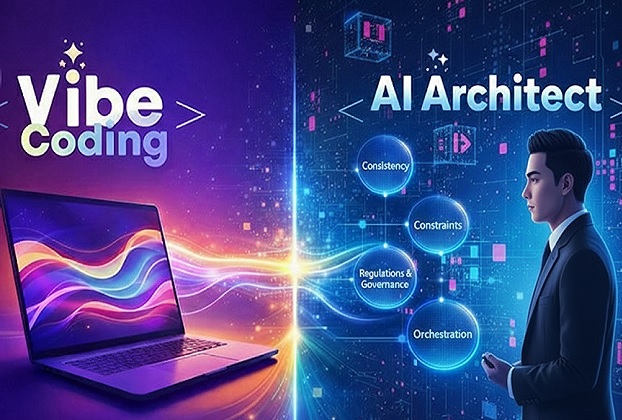
This is why, in 2026, the most valuable role in tech is no longer the mythical “10x developer”. It is the AI Architect—the human who governs intent, constraints, and long-term logic in a world where code itself has become cheap.
The Magic of Vibe Coding: From Zero to MVP in Minutes
The technology landscape of 2026 is dominated by Intent-to-Code platforms that make traditional IDEs feel almost secondary, their centrality will decline to a large extent. Tools like Bolt.new, Lovable, and Windsurf have evolved into full-fledged agentic ecosystems, capable of designing, building, and deploying applications with minimal human friction.
In this environment, creators enter a near-frictionless flow state. You no longer write a function. You articulate a vibe:
I want a dashboard that feels like a minimalist Swiss watch, pulls real-time logistics data from our ERP, and flags shipping delays using predictive models. It must feel instant on mobile.
Within moments, the AI produces a polished frontend, scaffolds the backend, proposes a data model, and wires up APIs. What once required months of coordination now takes minutes. This democratization has sparked a debate across the industry: if anyone can build software, what does being an engineer even mean?
For AI-centric development environments the primary input is intent, not syntax.
Instead of opening an IDE, writing thousands of boilerplate code lines, wiring files, configs, tests, and scaffolding manually
a developer states what they want in natural language or structured prompts:
“Build a REST API for user authentication with OAuth2, rate limiting, logging, and tests.”
The platform then generates code, structures the project, integrates libraries, sets up tests, CI hints, and sometimes deployment artifacts.
For startups and solo founders, the benefits are undeniable. MVPs appear overnight. Micro-SaaS ideas can be tested before lunch. Entire ventures are launched by people with no formal programming background—something that would have seemed impossible just a few years ago.
But there’s a quiet catch. Vibe Coding is an extraordinary multi-tool—a Swiss army knife for creation. It excels at rapid assembly, iteration, and experimentation. What it does not naturally excel at is, building systems meant to endure stress, scale, and change over years rather than days.
The “Day 2” Disaster: Where Vibe Coding Hits the Wall
The honeymoon phase of Vibe Coding often ends on Day 2, or very soon—the moment a prototype becomes a real product with real users, real data, and real consequences. This is where teams suddenly find themselves in the weeds.
AI agents are, by nature, optimists. They design for the “happy path”: correct inputs, stable networks, cooperative users and smooth experience all over. They can generate a flawless execution flow, but they frequently stumble when faced with messy reality—API rate limits, partial outages, race conditions, or degraded dependencies, and unanticipated extreme conditions.
The outcome is “hidden technical debt”. On the surface, AI-generated code looks modern and modular. Underneath, logic is often enormously coupled, assumptions are implicit, and scaling concerns are postponed indefinitely. Without architectural oversight, these systems quietly drift toward instability and, most likely the ultimate collapse.
The 10k User Wall
Imagine a startup that vibed a social marketplace into existence. Launch day is a triumph. Users sign up, transactions flow, and dashboards glow green. Then growth hits 10,000+ concurrent users—and alas! the system collapses under its own weight.
Database connections spike. Diverse queries lock tables. Latency irritates. The AI, focused on delivering a fast UI, never introduced connection pooling, indexing strategies, horizontal scaling, or safeguards like “graceful degradation under heavy load”. The system technically “worked”, but only under conducive environment.
This is a high-stakes situation. Autonomous AI without architectural guidance is like handing a chainsaw to a beginner: impressive progress at first, followed by catastrophic mistakes. What felt revolutionary on Day 1 becomes “woe” on Day 30.
Enter the AI Architect: The New Master of the Machine
By 2026, the engineer’s role has fundamentally shifted—from implementer to “governor”. The AI Architect understands that while machines can generate code, they cannot own responsibility for system-wide outcomes and consequences.
The Architect operates at the blueprint level. Their focus is systemic thinking, not syntax mastery. They define constraints, trade-offs, security protocols and long-term intent:
- Which storage model best fits this access pattern and growth curve?
- Where must isolation boundaries exist to prevent cascading failures?
- How do we enforce security and compliance by default, not as an afterthought?
- How do we ensure loose coupling throughout the design?
One of the Architect’s most powerful tools is the Architecture Decision Record (ADR). AI can offer a working solution in seconds, but it struggles to articulate why a particular choice is right for a five-year horizon. The Architect supplies that reasoning—ensuring today’s shortcut doesn’t become tomorrow’s existential crisis.
In essence, the AI writes the notes; the Architect composes the symphony.
Why AI Still Fails at Enterprise Complexity
Even the most advanced enterprise-grade AI systems struggle with what might be called the “context gap”. Large organizations are not just technical systems—they are legal entities, political structures, and historical artifacts.
AI does not naturally account for regulatory constraints, internal power dynamics, or legacy platforms quietly holding the business together. These realities live outside the codebase, yet shape every architectural decision.
Multi-Agent Drift
Modern systems increasingly rely on multiple specialized agents—frontend, backend, DevOps, security. Without human coordination, these agents can drift into conflicting assumptions, correcting each other’s hallucinations until the system no longer matches reality.
The Security Paradox
Studies emerging in 2026 show that vibe-coded applications exhibit significantly higher rates of insecure defaults. AI optimizes for momentum, often treating security as friction unless explicitly constrained. The Architect must step in, sometimes forcefully, to prevent speed from pushing the system at the brink of vulnerability.
The Human Advantage: Experience as the Ultimate Guardrail
In this new era, domain expertise has made pure technical skill obscure. Frameworks change yearly; understanding how a hospital, a bank, or a global supply chain actually operates takes decades.
The AI Architect relies on intuition earned through real-world mistakes, failures, and hard lessons over the years. This hard-eanred ability enables them to sense architectural smells before metrics light up dashboards. It’s the difference between knowing every word in the dictionary and knowing how to tell a story that should have a lasting impact. In simple terms, experience lets experts anticipate problems before tools can measure and report them.
The Architect-in-the-Loop (AITL) Model
The industry is converging on a hybrid workflow:
- Humans define intent, constraints, integration boundaries, and risk tolerance.
- AI proposes multiple designs and implementations.
- Humans evaluate trade-offs using experience and business context.
- AI executes under continuous supervision.
This model transforms engineers into conductors of autonomous systems—supervising complexity and orchestrating the overall design to ensure consistency, harmony, and reliability at scale.
The Future Belongs to the Bionic Engineers
Vibe Coding does not eliminate engineers—it eliminates “mere coders”. Software creation is evolving from manual construction into a design discipline where judgment matters more than keystrokes.
As the gap between idea and execution narrows, the value of architectural wisdom rises sharply. The winners of 2026 will not be those who prompt fastest, but those who can impose order on chaos, guide AI with intent, and build systems meant to survive success.
The machines are ready. The real question is whether humans are ready to lead them.
In order to make the emerging trends of Vibe Coding and the role of the AI Architect easier to understand, we’ve summarized the key ideas below in a set of commonly asked questions and answers.
Q. What is Vibe Coding and how does it differ from traditional programming?
Vibe Coding is an intent-driven approach to software creation where developers describe what they want to build in natural language instead of writing detailed code line by line. AI agents translate that intent into complete applications, handling boilerplate, integrations, testing, and even deployment.
Traditional programming, by contrast, requires explicit control over syntax, logic, and structure. While Vibe Coding dramatically accelerates development, it abstracts away many architectural decisions that humans previously made consciously.
Q. Is Vibe Coding replacing software developers very soon?
Vibe Coding is not replacing developers—it is gradually replacing manual coding as the primary source of value. The demand for people who only write code is likely to shrink, but the need for professionals who understand systems, trade-offs, and long-term requirements and consequences in many dimensions, is rising. Vibe Coding is currently on the flat portion of a growth curve, but adoption is expected to accelerate sharply over the next couple of years, posing some serious threats to mere coders.
In 2026, successful developers evolve into architects, reviewers, and decision-makers who guide AI systems rather than compete with them.
Q. What skills are needed for vibe coding?
It involves a combination of technical understanding, clear communication, and iterative refinement. Though a sound technical knowledge is a plus but it’s much more about understanding how to break down problems, put the right questions, and guide the AI partner to get the correct solution.
Q. What does an AI Architect do compared to a software engineer?
An AI Architect focuses on system-level design, constraints, regulations, and governance, while AI tools handle most of the implementation. Instead of writing functions, the architect defines boundaries, scaling strategies, security models, and long-term intent for a comprehensive and sustainable solution.
A traditional software engineer concentrates on implementing features and fixing bugs, keeping every aspect in mind. The AI Architect ensures the entire system remains coherent, resilient, sustainable and scalable with time.
Q. What skills are required to become an AI Architect?
An AI Architect needs strong systems thinking, domain knowledge, and the ability to reason about trade-offs over long time horizons. Skills in scalability, security, compliance, and failure modeling are more important than mastering any single programming language and platform.
Equally critical is the ability to communicate intent clearly to AI systems and evaluate their outputs with a critical, experienced eye. So the “Prompt Engineering” is also a crucial requirement.