Introduction: The End of Single-Paradigm Computing
For most of its history, computing has progressed by leaning heavily on a single dominant physical paradigm at any given time. Early machines relied on mechanical motion, which gave way to electromechanical relays, and eventually to fully electronic systems built on vacuum tubes and later transistors. Each transition felt decisive, almost final, as if one paradigm had conclusively replaced the previous one. That historical pattern, however, is quietly breaking down.
Despite decades of steady transistor improvements, modern computing systems are no longer scaling in the smooth, predictable way engineers once took for granted. Raw transistor counts continue to increase, and fabrication technologies keep pushing the envelope, but system-level performance, energy efficiency, and scalability are increasingly difficult to improve in tandem. Heat dissipation, data movement, and coordination across complex hardware stacks have become a tough nut to crack, especially as computing workloads spill deeper into the digital realm and expand into time-critical applications that cannot afford to tolerate latency or inefficiency.
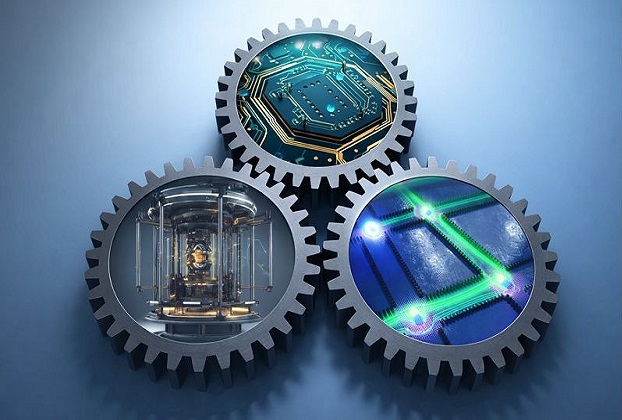
The central argument of this article is deliberately modest and grounded: the future of computing is not about replacing electrons with photons, nor substituting classical machines with quantum ones. Instead, it is about orchestrating electrons, photons, and qubits together, allowing each to operate where it naturally excels. As electrons, photons, and qubits begin to coexist within the same computational pipelines, computing is steadily evolving toward hybrid architectures designed to balance performance, efficiency, and scalability.
This discussion avoids hype, avoids claims of technological supremacy, and avoids speculative timelines. There will be no promise of instant breakthroughs or all-in-one solutions that magically solve every problem.
What is emerging instead is a hybrid model. Classical electronic computing remains responsible for mainstream deterministic logic and control because it is the best on it. Photonic technologies increasingly handle data movement and certain forms of acceleration. Quantum processors occupy a specialized role, tackling narrow but high-impact problem classes. Together, these elements signal that computing is approaching a tipping point, not because any single technology has failed, but because the complexity of modern challenges now demands a multi-pronged architectural solution.
The Classical Foundation: Why Traditional Electrons Still Dominate
Electronic computing remains the backbone of the modern world for reasons that are both technical and practical. Classical computers offer determinism, reliability, and predictability, qualities that are essential for handling high-stakes decisions in domains such as business, finance, healthcare, infrastructure, and national security. Over decades, a formidable ecosystem has grown around electronic computing, including programming languages, operating systems, compilers, development tools, security practices, and cyber hygiene frameworks designed to protect data and systems at scale.
This maturity is not accidental. Semiconductor manufacturing, particularly CMOS technology, has reached an extraordinary level of economic and technical refinement. Entire global supply chains are optimized to produce reliable electronic components at scale, making classical computing the gold standard for general-purpose workloads at large. The digital footprint of nearly every organization, from startups to governments, depends on this foundation.
Yet the challenges facing classical computing today have little to do with the transistor itself. Power density has become a persistent concern, as packing more transistors into smaller spaces leads to heat dissipation issues that limit clock speeds.
The memory wall continues to widen, with processors waiting idly for data to arrive from distant memory hierarchies. Interconnect latency and the energy cost of moving bits across chips, boards, and data centers increasingly dominate system performance. Even as technology advances exponentially, the returns from frequency scaling and simple architectural tweaks are diminishing.
It simply means that while we can still pack more transistors onto chips, but simply increasing clock speeds or making small CPU design tweaks is no longer going to deliver big performance gains. Power, heat, and memory-access limits prevent frequencies from scaling like they once did. As a result, each incremental improvement now yields disappointingly smaller benefits than before. Traditional electronics have hit practical efficiency ceilings, not innovation limits.
It would be misleading to frame this situation as a failure of classical computing. What is happening instead is that electronic systems are being pushed far beyond the design assumptions under which they originally thrived. Classical CPUs are no longer just number crunchers; they are orchestrators, schedulers, and coordinators of vast, heterogeneous systems. In this role, they remain indispensable, forming the controlling entity of every serious computing architecture on a whole new level of complexity.
Photons Enter the Picture: Computing’s Data Movement Crisis
As computation itself becomes cheaper and faster, the hidden cost of moving data has come into limelight. In modern systems, the energy required to transport bits from memory to processor, or from one chip to another, often exceeds the energy required to perform the computation itself. This imbalance becomes especially pronounced in large-scale systems such as data centers, AI training clusters, and distributed platforms that must keep up with real-world challenges involving massive data flows.
Electronic interconnects, while versatile, suffer from resistive losses, electromagnetic interference, and scaling limitations. As distances increase and bandwidth demands grow, these issues increase manifold. The result is that performance is increasingly constrained not by how fast calculations can be performed, but by how efficiently information can be delivered to where it is needed. This is where Photonics enters not as a novelty, but as a necessity.
Photonic technologies use light rather than electrical charge to transmit information. Light offers near-zero resistive loss, high bandwidth density, and predictable latency over long distances. It is largely immune to electromagnetic interference, making it especially attractive in dense, high-performance environments. In practical terms, photonics enables data movement at scales and speeds that electronic interconnects struggle to match without excessive power consumption.
Importantly, photonics is already deeply embedded in modern infrastructure. Data center interconnects, long-haul fiber networks, and increasingly chip-to-chip optical I/O rely on photonic components. These systems are not experimental curiosities; they are becoming the gold standard for moving information efficiently across physical boundaries.
At the same time, it is critical to understand what photonics does not replace. Light-based systems are not well-suited for general-purpose Boolean logic, nor do they offer a straightforward replacement for electronic memory. Their role is focused and precise: accelerating movement and certain mathematical operations where parallelism and bandwidth dominate. In this sense, photonics elevates computing by addressing its most pressing bottleneck rather than attempting to reinvent its foundations.
Key Roles of Photonics
Photons travel faster than electrons in a wire, allowing for data transfer at nearly the speed of light with minimal latency. Unlike electrical currents which is based on electrons, photons do not generate significant heat as they travel through optical fibers or other mediums. The remarkably high frequency of light allows for significantly greater bandwidth, meaning multiple data streams can be transmitted simultaneously on the same chip or medium using different wavelengths. Photonic interconnects with traditional electronics based architectures enable the rapid data exchange required for complex scientific simulations and AI training, pushing the boundaries of high-scale computing systems.
Qubits and Quantum Computing: Power With Narrow Scope
Quantum computing represents a fundamentally different approach to computation, one that leverages the principles of superposition and interference to explore large solution spaces in ways that classical systems cannot efficiently replicate. Unlike electronic or photonic computing, quantum computation is inherently probabilistic, operating on quantum states that encode information across exponentially large spaces under carefully controlled conditions.
This power, however, comes with strict constraints. Quantum computers are well-suited for specific classes of problems, including optimization, quantum simulation, and certain linear algebra workloads that underpin cryptography and materials science. In these domains, quantum approaches can offer genuine advantages, not by performing tasks faster in a general sense, but by performing them differently.
What quantum computing is not, however, is a faster version of a classical CPU. It does not run operating systems, manage user interfaces, or replace traditional workloads. It is not a standalone system, nor does it eliminate the need for classical infrastructure. Quantum processors depend heavily on classical computers for pre-processing inputs, post-processing results, error correction, calibration, and orchestration. Without classical control systems, quantum hardware cannot function meaningfully.
This dependency underscores a critical insight: quantum computers are accelerators, not replacements. They extend the computational toolkit rather than redefining it entirely. Their role is narrow but potentially game-changing within that scope, especially as organizations navigate uncharted waters involving complex optimization and simulation tasks that classical methods struggle to address efficiently.
The Case for Hybrid Architectures: Why No Single Paradigm Can Scale Alone
Each computing paradigm encounters different physical limits. Electronic systems combat heat and leakage currents. Photonic systems face challenges related to weak non-linearity and integration with electronic control. Quantum systems contend with noise, decoherence, and extreme sensitivity to environmental conditions. These constraints are not temporary engineering inconveniences; they are rooted in fundamental physics.
What makes hybrid architectures compelling is that these limitations are largely complementary rather than overlapping. Where electrons struggle with long-distance communication, photons excel. Where classical systems fall flat in certain optimization landscapes, quantum systems offer alternative pathways. Hybrid systems do not emerge because engineers prefer complexity, but because reality demands and compels it.
This pattern is not entirely new. CPUs did not eliminate GPUs, nor did GPUs render specialized accelerators obsolete. Instead, specialization became the norm. The difference today is that specialization now spans physical domains, not just architectural ones. Hybrid computing is therefore best understood as a structural response to physics, driven by necessity rather than fashion.
What “Hybrid Computing Synergy” Actually Looks Like
In practice, hybrid computing architectures are layered and orchestrated rather than monolithic. Classical CPUs sit at the center, coordinating workflows, managing memory, enforcing security, and maintaining system resilience. GPUs and other accelerators handle massively parallel workloads, while photonic interconnects move data efficiently across chips and systems. Quantum Processing Units (QPUs), where available, function as specialized offloaded accelerators, invoked for tightly scoped computational sub-tasks that exploit quantum effects—while the bulk of data handling and control remains classical.
The software layer is where much of the real complexity resides. Classical scheduling systems manage task allocation, ensuring that data is marshaled correctly between domains with vastly different performance characteristics. Hybrid algorithms, particularly in quantum-classical workflows, involve iterative feedback loops in which classical systems refine inputs based on quantum outputs. This orchestration demands careful design, especially when handling time-critical applications or high-stakes decisions.
Many modern data centers already exhibit elements of hybrid computing, even if they are not labeled as such. AI pipelines rely on optical interconnects to sustain bandwidth demands. Optimization workloads increasingly explore quantum-assisted approaches. These systems illustrate that hybrid does not mean tightly connected coherent hardware, but loosely coupled components working together under precise control.
Engineering Challenges and Trade-offs
The solutions of hybrid computing do not guarantee being without friction. Interface overheads between paradigms can erode theoretical gains if not carefully managed. Different error models complicate reliability guarantees, particularly when quantum and photonic components interact with classical systems. Programming such systems requires new abstractions and skills, creating gaps in tools and talent.
Economic considerations also play a role. Manufacturing hybrid systems is expensive, and integrating emerging technologies into production environments demands careful risk management. These challenges reinforce the need for thoughtful design and disciplined expectations. Hybrid computing is powerful, but with great power comes great responsibility, especially when systems operate at the core of critical infrastructure.
What This Means for the Future of Computing
The future of computing increasingly resembles a stack of physics rather than a single dominant paradigm. Domain-specific acceleration is becoming the norm, classical computing remains central, photonics continues its quiet yet steady diffusion through infrastructure, and quantum computing matures cautiously within defined boundaries, yet has a monumental potential to solve extremely complex problems in a pretty short time.
Technology advances exponentially, and at this point, it is no longer a choice whether you want to keep up with it or not. Organizations and individuals alike must adapt to a landscape where hybrid systems are not optional experiments, but practical responses to complexity. Hyper-automation, resilient architectures, and careful attention to digital footprints will define success in this environment.
The future of computing is not electronic, photonic or entirely quantum. It is architecturally hybrid. This powerful synergy requires moving away from replacement thinking toward systems thinking scenario, recognizing that the most powerful solutions emerge when technologies cooperate rather than compete.
The most enduring computing systems will be those that respect physical limits, embrace specialization, and approach complexity with clarity rather than hype. In doing so, they will push the envelope not by ignoring constraints, but by working intelligently within them. Hence, the most realistic path forward lies in hybrid computing architectures, where electrons, photons, and qubits coexist — each handling the tasks they are best suited for.
You may also be interested in these articles:
Hybrid Computing: The Best of Both Worlds?
The Future of Cybersecurity: A Comprehensive Guide to Post-Quantum Cryptography and Its Impact on the Digital World
Quantum Computing – The Big Wave