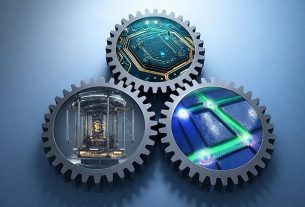
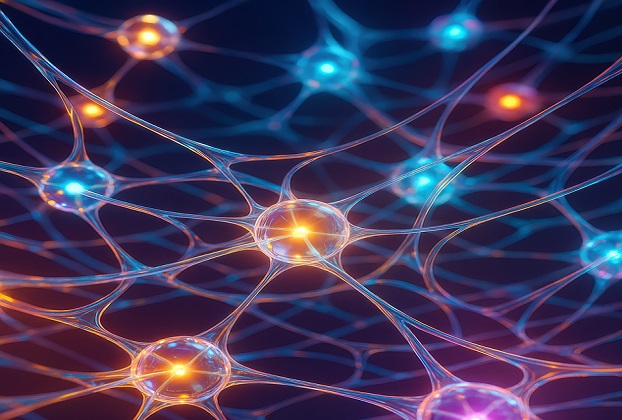
In the simplest terms Deep learning is a subset of machine learning that uses artificial neural networks to learn from data, quite similar to the way we learn.
Deep learning did not announce itself with fireworks. It slipped into our lives quietly, almost out of the blue, and before we could fully grasp what was happening, it had woven itself into the fabric of our daily routines. You unlock your phone with your face. You speak to a digital assistant that somehow understands your intent. Streaming platforms recommend content so accurately that it feels uncanny. Cameras recognize people, objects, and even emotions. What once felt dazzling and futuristic is now ordinary, almost invisible.
This silent takeover is precisely what makes deep learning so fascinating. It is not like a regular software. It does not demand attention. It simply works—behind the curtain, inside the modern AI ecosystem, shaping decisions, experiences, and expectations. Yet despite its buzz-worthy reputation, deep learning is often misunderstood as something super complex, mathematical, and incomprehensible. Many people assume it is reserved for PhDs, research labs, or AI geeks-and that’s absolutely wrong.
As a simple analogy, think of deep learning as the natural developmental process of a human being. From just a few months old, a baby begins learning by watching, listening to, and observing their surroundings. Over time, they become capable of identifying people, naming objects, and understanding daily routines—often with little to no formal instruction from their parents.
This article places a clear spotlight on deep learning and explains it in a way that feels intuitive, grounded, and alluring. You do not need to build neural networks or boil the ocean of theory to understand how machines learn to see, hear, and think. You only need the right mental model.
Why Deep Learning Is Everywhere Today
Deep learning has wide-ranging applications, from chatbots and self-driving cars to facial and speech recognition. The reason deep learning feels omnipresent is because it thrives wherever human perception and judgment are involved. Every time your phone unlocks using face recognition, a deep learning model is at work, comparing subtle patterns in your facial features against what it has learned before. When a voice assistant responds accurately despite background noise or an accent, deep learning is parsing sound waves into meaning. When recommendation engines seem to read your mind, they are actually recognizing behavioral patterns across millions of users.
Earlier generations of software struggled in these areas because they relied on rigid, rule-based logic. Developers had to anticipate every scenario in advance. If the rules did not cover a typical situation, or a set of scenarios, the software failed. This worked fine for accounting systems and databases, but it collapsed when confronted with the messy, ambiguous nature of the real world.
Deep learning tossed away that fragile rules methodology and replaced it with learning itself. Instead of explicitly telling machines what to do, we show them examples and let them adapt. That single shift is why deep learning now dominates image recognition, speech processing, language translation, and pattern recognition across the digital ecosystem.
Once you see this shift clearly, the widespread adoption of deep learning no longer feels accidental. It feels inevitable.
From Traditional Programming to Learning Machines
To appreciate why deep learning is a trailblazing idea, it helps to understand what came before it. Traditional programming followed a predictable structure. Data went in, rules were applied, and outputs came out. This approach assumed that humans could fully describe the problem space in advance.
For simple, well-defined problems, that assumption holds. For real-world perception, it collapses. No one can write a complete rulebook for recognizing every possible scenario, understanding every spoken sentence, or interpreting every visual scene. The real world is too fluid, too noisy, and too context-dependent.
Deep learning flipped the model entirely. Instead of feeding machines rules, we feed them examples. Instead of hard-coding logic, we allow systems to learn patterns directly from data. The machine gradually adjusts itself until it can generalize from what it has seen before to what it encounters next.
A useful analogy is the difference between writing instructions and teaching by experience. When you teach a child what a dog is, you do not list defining rules. You show dogs. Over time, recognition emerges naturally and the child eventually becomes capable to distinguish between a cat and a dog. Deep learning rests on the same spine. It learns by exposure, correction, and repetition, not by memorization of rigid instructions.
This philosophical shift is what changed everything in artificial intelligence. It allowed machines to move beyond brittle automation and into a sustainable adaptive behavior.
What “Deep” in Deep Learning Actually Means
The word “deep” often sounds like marketing hype, but in deep learning it has a very concrete meaning. Depth refers to layers—layers of processing, layers of abstraction, and layers of understanding. Each layer takes what came before and refines it further.
Consider human vision. The eyes detect raw light. The brain identifies edges, then shapes, then objects, and finally meaning. You do not consciously perform these steps, but they happen sequentially. Deep learning models mimic this layered interpretation.
At the earliest stage, raw inputs such as pixels or sound waves are processed. In the middle, increasingly abstract features are detected. By the final stage, the system produces a meaningful output such as a label, a prediction, or a response. These stages are often described as input layers, hidden layers, and output layers, but the terminology matters far less than the intuition.
What makes deep learning powerful is not any single layer, but the way many simple transformations stack together. Visualizing this as progressive understanding rather than laid-down technical architecture helps demystify why depth matters. It is not about complexity for its own sake. It is about building meaning gradually.
Artificial Neurons: The Smallest Thinking Units
At the core of every deep learning model lies an artificial neuron. Despite the biological inspiration, artificial neurons are far simpler than their human counterparts. They do not think, reason, or understand. They perform one task exceptionally well: deciding whether a signal is worth passing forward.
Each neuron receives inputs, assigns them relative importance, adds them together, and applies a simple decision function. The often-quoted formula—output equals activation of weighted inputs plus bias—exists only to formalize this intuition. The math itself is not the magic. The meaning is.
One neuron alone is unimpressive. Millions of them, connected across layers, become transformative. Instead of relying on handcrafted logic that breaks easily, deep learning uses massive numbers of simple units to model complex patterns. This is why systems built on artificial neurons routinely outperform rule-based software in perception tasks.
The brilliance of deep learning lies in its humility. Rather than attempting to encode intelligence explicitly, it allows intelligence to emerge from accumulation and feedback.
How Deep Learning Learns: Errors, Feedback, Improvement
Learning in deep learning follows a rhythm that feels surprisingly human. The system makes a prediction, compares it to reality, measures the error, and adjusts itself slightly. This cycle repeats thousands or millions of times until performance stabilizes.
The error is often called loss, but conceptually it is just a measure of how wrong the system was. The key innovation lies in how this error is used. Feedback travels backward through the network, nudging each neuron to adjust its influence. This process, known as back-propagation, is best understood as structured correction rather than technical machinery.
A familiar analogy is practicing a physical skill. You try, fail, receive feedback, and improve. No single attempt matters. Progress emerges from repetition, learning and improvement. Deep learning systems learn in exactly this way, refining their internal structure incrementally until predictions become reliable.
This approach allows learning to scale. Instead of rewriting rules, the system continuously self-adjusts. That adaptability is why deep learning can go full throttle once enough data is available.
Artificial Neurons and Deep Learning
At the heart of deep learning lies the artificial neuron—a mathematical unit that takes inputs, multiplies them by weights, adds a bias, and passes the result through an activation function. Unlike biological neurons, these units don’t “think” or “understand”; they simply decide whether a signal is strong enough to pass forward. One neuron alone is trivial, but millions of them, layered together, can recognize complex patterns such as handwritten digits or spoken words.
Training a deep learning model involves presenting it with labeled examples—for instance, an image of the digit “3.” The model produces an output, compares it with the correct label, and calculates an error. Through back-propagation, this error is distributed backward across the network, and each neuron adjusts its weights slightly. Over thousands of cycles, the network learns which pixels or regions matter most, gradually improving its accuracy.
A key point is that no human assigns specific roles to neurons. The architecture (designed by humans) determines how neurons are connected—whether each sees all pixels (fully connected) or just a small patch (convolutional). But the training process itself decides what each neuron learns to detect. One neuron may become sensitive to vertical lines, another to curves, and together they form the “pieces of the puzzle” that assemble into a complete recognition of the digit.
In essence, deep learning works because of collective effort: individual neurons handle small fragments of information, layers combine these fragments into larger features, and the whole network integrates them into a final decision. The power lies not in any single neuron, but in the way millions of them collaborate to solve problems that rule-based software cannot.
Why Deep Learning Needs So Much Data
One of the most common criticisms of deep learning is its appetite for data. This hunger is not a flaw; it is a requirements in order to reach accuracy. Deep models can represent extraordinarily subtle patterns, but only if they are exposed to enough examples.
With limited data, a model tends to memorize rather than generalize. It performs well on what it has seen but fails in the real world. This phenomenon, known as overfitting, mirrors human learning when someone studies only exam questions instead of concepts.
The rise of deep learning coincided with three enabling forces: massive data generation across the digital ecosystem, powerful GPUs capable of parallel computation, and cloud infrastructure that made large-scale training feasible. Together, they created a downpour of opportunity.
Without these pillars, deep learning would have remained theoretical. With them, it realized its potential and reshaped entire industries.
Types of Problems Deep Learning Excels At
Deep learning thrives wherever patterns are rich and explicit rules fail. In visual tasks, it recognizes objects, faces, and scenes with accuracy that rivals or exceeds human performance. In audio processing, it converts speech into text, filters noise, and identifies speakers. In language understanding, it translates, summarizes, and generates text by modeling linguistic patterns rather than grammatical rules.
In predictive domains such as finance and healthcare, deep learning identifies correlations buried deep within complex datasets. It does not replace human judgment, but it surfaces insights that would otherwise remain hidden. These capabilities are why deep learning continues to get more eyeballs on every industry it touches.
Where Deep Learning Still Struggles
Despite its strengths, deep learning has limits that experienced IT professionals should not ignore. It requires enormous amounts of data and compute, raising concerns about energy consumption and sustainability. Its internal decision processes are often opaque, making explainability difficult. Bias in training data can be amplified rather than corrected.
Most importantly, deep learning does not understand context or intent. It recognizes patterns without comprehension. Treating it as human-level intelligence may cause disappointment and risk. Maintaining cyber hygiene, ethical oversight, and human accountability remains essential.
Acknowledging these weaknesses does not diminish deep learning. It strengthens trust.
Deep Learning vs Machine Learning: Clearing the Confusion
Machine learning is the broader discipline concerned with systems that learn from data. Deep learning is a specialized subset that uses multi-layered neural networks. Traditional machine learning techniques remain valuable when data is structured, interpretability matters, and resources are constrained.
Deep learning is best suited for the scenarios where scale, complexity, and unstructured data dominate. The two approaches are complementary, not competitive. Knowing which to apply—and when to toss away unnecessary complexity—is a mark of mature engineering judgment.
Is Deep Learning Replacing Human Intelligence?
The fear of an AI apocalypse often stems from misunderstanding what deep learning actually does. It excels at pattern recognition, not reasoning. It is narrow intelligence, not general intelligence. It cannot define goals, question assumptions, or apply moral judgment.
Humans remain essential in framing problems, interpreting results, and guiding ethical use. Rather than replacement, the future points toward collaboration. Machines handle repetition to ensure gradual correct. Humans provide meaning.
How Deep Learning Will Shape the Next Decade
Over the next decade, deep learning will continue to evolve from tool to collaborator. Assistants will become more contextual. Autonomous systems will adapt in real time. AI copilots will assist developers, analysts, and professionals across domains.
This evolution will reward those who stay ahead of the curve—those willing to roll up their sleeves and engage with the technology thoughtfully. The sky’s the limit, but only if human intent remains in the loop.
Why Understanding Deep Learning Matters
Understanding deep learning is no longer optional for anyone navigating modern technology. It is not just for AI engineers. It is foundational literacy for developers, managers, and tech-aware individuals alike.
You do not need to build neural networks to understand how they shape your world. You only need clarity. Once that clarity arrives, deep learning stops feeling super complex and starts feeling inevitable—a natural outcome of data, computation, and learning converging at scale.
And when that realization clicks, deep learning no longer feels mysterious. It feels like the logical next chapter in the story of intelligent machines.
You may also be interested in reading these articles:
Vibe Coding vs. System Architecture: Why the ‘AI Architect’ Is the Top Job of 2026 and Beyond
Electrons, Photons, and Qubits: How Computing Is Evolving Toward Hybrid Architectures
The Rise of AI Co-Workers: What IT Teams Look Like in 2026
Beyond Biometrics: Leveraging BWE Data To Train AI/ML Models For Personalized Mental Wellness Platforms