
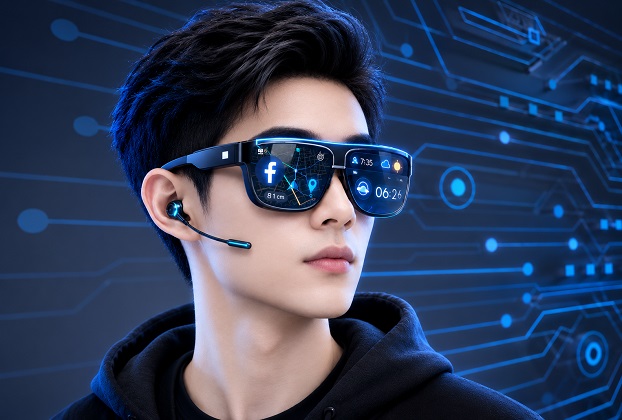
Imagine walking through a grocery store with a pair of smart glasses on. You pick up a product you’ve never bought before. Instead of turning the package around and trying to read a tiny ingredient label, you simply look at it. Your AI assistant quietly tells you that it contains a preservative your body doesn’t handle well, that it expires in three days, and that a fresher, cheaper alternative is two shelves away.
Now imagine a completely different situation. It’s a flat, low-energy afternoon, and you haven’t even said that you’re tired. Your AI companion notices the signs because it knows you slept less than usual, your calendar is packed, and you tend to skip lunch on days like this. Rather than waiting for you to ask for help, it gently suggests a fifteen-minute walk, reminds you to eat, and perhaps even plays your favorite playlist to improve your mood.
Or picture yourself on a tennis court, or behind the wheel after years without driving. Instead of a human coach standing beside you, your AI assistant is observing the same things you are: the ball, the road, your grip, your posture, and your movements. It can then point out a mistake and guide you in real time, without requiring you to explain what just happened.
Take it one step further. You’re jogging along your usual, rather boring route around the block, but through your glasses the grey pavement and traffic noise are transformed into a peaceful forest trail, complete with birdsong. At the same time, you remain aware of the real cars, cyclists, pedestrians, and buildings around you.
And after a long day, imagine putting on the same device you wore throughout the day, closing your eyes, and letting a carefully designed combination of light and sound help bring your brain from a stressed-out “9” down to a calmer “3” — without opening another app, taking a pill, or driving to a wellness studio.
These scenarios may sound like science fiction, but they are not dependent on one magical device. They represent the convergence of several technologies: artificial intelligence, augmented and virtual reality, biometric sensing, and, eventually, technologies such as 6G and, may be quantum-assisted computing. Some of these capabilities are already available in consumer products. Others are close enough to be only a hardware generation or product announcement away. A few, however, still need several years of technological progress.
So, where does the idea of AI goggles or smart glasses becoming the next phone actually stand in the middle of 2026? Let’s separate what is already practical from what is coming soon, what is still a few years away, and what remains genuinely futuristic.
What’s Already Common or in Practice
The basic concept of wearing glasses that have an AI assistant, can understand what you’re looking at, and can communicate with you throughout the day is no longer just a prototype. It has become a real and rapidly growing consumer technology category.
Ray-Ban Meta is perhaps the clearest example. These glasses combine an on-frame camera, an AI button that lets you ask questions about what is in front of you, and open-ear speakers for phone calls and music. The line reportedly sold roughly 6.5 million units in 2025 alone. By 2026, smart glasses as a broader category had overtaken VR headset sales for the first time, suggesting that this technology is moving beyond hobbyists and early adopters. Meta has also expanded the range into sport-oriented and prescription-friendly designs, making the idea of “smart glasses that look like normal glasses” increasingly realistic.
Meta Ray-Ban Display pushes the concept another step forward by adding an actual in-lens display. Instead of keeping all information on your phone, a small heads-up display in one eye can show text, navigation information, captions, and AI responses. A wristband can also detect subtle finger gestures for control. This is not the fully immersive augmented-reality experience portrayed in science fiction, but it is a real example of digital information appearing directly in your field of view.
Even Realities G2 and Rokid AI Glasses represent another direction: lightweight, productivity-focused glasses designed to look relatively ordinary rather than like bulky VR equipment. They offer features such as built-in AI assistance and live translation across well over a hundred languages. Companion devices, including smart rings, can also provide controls and health-related measurements such as heart rate, blood oxygen, and sleep stages. Taken together, these products are beginning to resemble the early version of an AI companion that can quietly understand parts of your health and daily routine.
What about the grocery-store example? The technology already exists, although it currently lives primarily on smartphones rather than directly inside your glasses. A growing range of AI-powered food and ingredient-scanning apps can use a phone’s camera to examine a product or a plate of food and provide information about ingredients, additives, allergens, and whether the food matches a user’s dietary profile. Moving that same camera from a smartphone to a pair of smart glasses is therefore more of a form-factor change than a completely new concept.
What’s Around the Corner
Several other parts of this vision are close enough that they may arrive through the next one or two hardware generations rather than requiring a technological revolution.
Google and Samsung’s Android XR glasses, built around Google’s Gemini assistant, are rolling out through 2026 with an important idea at their core: an AI assistant that understands your physical surroundings rather than merely responding to spoken commands. Samsung’s Project Moohan headset has already been demonstrated, while standalone Android XR glasses are expected to follow. Apple is also widely reported to be preparing its own smart glasses, potentially arriving in 2026 or shortly afterward as part of its broader AI strategy.
Snap Specs provide a glimpse into the more immersive and independent end of the market. They combine dual processors, including one dedicated to computer vision, with hand tracking, spatial mapping, and a genuine waveguide display. The goal is to create an AR device that can operate without constantly depending on a phone. These glasses are bulkier and more expensive than the Ray-Ban-style products, but they represent a real standalone AR system rather than simply a concept illustration.
The proactive, mood- and habit-aware AI “buddy” described earlier is also technically possible today. Imagine combining biometric rings and glasses that collect information about sleep, heart rate, and activity with an AI model that can access your calendar and historical behavior. Every individual component already exists. What has not yet arrived as a mainstream product is a single, seamless system that combines all of them into one genuinely proactive experience.
That distinction is important. The technology gap here is not necessarily about inventing something completely new. It is about integrating existing technologies reliably, privately, and naturally enough that people actually want to use them every day. That makes this feel more like a months-or-a-few-years problem than a decades-away problem.
What’s a Few Years Away
Other parts of the vision require meaningful advances in display technology, battery capacity, processing efficiency, and networking. The challenge is not simply making these features work; it is making them work comfortably and continuously in something that still feels like a pair of glasses.
Full environment-blending AR — the ability to make your normal jogging route look and sound like a forest while maintaining awareness of the real world — remains limited by hardware. To do this convincingly in bright daylight, glasses need sufficient processing power, sensors, bright displays, and battery capacity without becoming so heavy that they feel like a helmet.
Today’s closest consumer alternatives, including products from VITURE and XREAL, can provide impressive virtual-screen experiences, but they often depend on a phone or a separate computing puck and are better suited to displaying a virtual screen than seamlessly replacing your surrounding environment with an immersive AR layer. As chips become more efficient and displays become brighter without exhausting the battery in ninety minutes, this area should mature over the next two to four years.
AI-guided skill training in VR and AR is a similar story. Real-time coaching for activities such as table tennis or driving already exists, particularly through dedicated VR headsets such as Meta Quest. The difficult part is shrinking that experience into lightweight glasses that you can comfortably wear all day while still providing accurate motion tracking and useful real-time feedback. That is an engineering challenge involving sensors, processing, battery life, and display technology — not merely a matter of writing better AI software. Realistically, this is still a few product generations away.
6G connectivity could eventually make these experiences considerably more capable. The basic idea is that more demanding AI and AR processing could happen in the cloud while the glasses themselves remain relatively lightweight. However, 6G is still in the standards-development and early-trial stage. Industry roadmaps point toward pre-commercial trials around 2028 and commercial deployment around 2030.
Until then, today’s AI glasses have to make do with 5G, Wi-Fi, and increasingly capable on-device AI chips. Those technologies are already good enough for many practical applications, but they still impose compromises involving latency, processing capability, connectivity, and battery consumption.
Quantum-assisted AI is considerably further away than some technology headlines might suggest. The idea is to use quantum computing to make an AI companion smarter or faster, perhaps by solving certain computational problems more efficiently. But as of mid-2026, quantum computers remain largely in pilot and proof-of-concept stages for specialized tasks such as molecular simulation and optimization.
Large-scale, fault-tolerant quantum computers capable of providing a meaningful advantage to everyday consumer AI are not expected until at least the early-to-mid 2030s. In the nearer term, the quantum development that matters more to devices such as AI glasses is actually defensive rather than flashy: post-quantum cryptography. Security-conscious organizations are already moving toward quantum-resistant encryption standards in preparation for the day when sufficiently powerful quantum computers could threaten some of today’s encryption methods.
What’s Still Genuinely Far Off
There are also parts of this vision that are not just one product generation away. It is important to be honest about those limitations rather than presenting every futuristic idea as though it is already around the corner.
Built-in light-and-sound brainwave entrainment integrated directly into everyday AI glasses does not currently exist as a shipping consumer product. Standalone devices that use light and sound for meditation or relaxation do exist, and they have a real — although still debated — evidence base. However, no mainstream glasses maker has announced an all-day wearable that combines this capability with AI glasses.
There is also a practical hardware problem. Such a feature would require carefully tuned light and audio systems while competing with the glasses’ other responsibilities, including cameras, displays, speakers, sensors, wireless connectivity, and battery life. It may therefore eventually become an optional or dedicated mode, or even a separate accessory, rather than something that continuously operates in the background.
The other major challenge is the truly deep, adaptive AI companion. A system that can accurately infer your mood from minimal input, remember your personality and preferences over many years, understand your behavioral patterns, and respond more like a close friend than a highly capable assistant is primarily an AI and software challenge.
Today’s on-glasses assistants are still mostly transactional: you ask something, and the system provides an answer. The much bigger leap is creating an AI that genuinely understands the context of your life while maintaining appropriate privacy, reliability, and user control. Better glasses alone cannot solve that problem. It depends on broader progress in artificial intelligence itself.
The Bottom Line
AI Goggles of the Future — Your Polymath AI Partner to Get Things Done, Conveniently — 24/7/365. No Matter What You’re Doing or Where You Are! The vision is already taking shape — but for the near-perfect experience, we’ll have to wait a little longer.
The device you’ve perhaps been imagining for years is closer than it may seem — but there is an important catch: it isn’t really one device yet. It is the convergence of several technologies that are progressing at very different speeds.
The basic AI assistant that can see what you see, answer questions, translate speech, provide navigation, capture photos and video, and handle notifications is already real and available on consumer products. The ingredients needed to create a more health- and mood-aware companion are also largely available, making the next year or two particularly interesting.
Full immersive environment blending, sophisticated built-in skill coaching, and connectivity that makes demanding AI and AR experiences feel instant and effortless are more realistically a few years away. Those capabilities depend on improvements in batteries, displays, sensors, processors, and networks that are already underway but are not yet mature enough for an ideal all-day glasses form factor.
And then there are the more ambitious ideas: brainwave entrainment built into everyday eyewear and an AI companion that understands you with the depth of another person. Those remain meaningfully further away. However, you don’t necessarily have to wait years to explore brainwave entrainment. Quality pre-programmed brainwave-entrainment sessions are already available online. You can choose one that matches your desired state and start using it right away. For this particular purpose, there’s no need to wait for AI assistance.
Still, the overall direction is becoming increasingly clear. Major technology companies such as Meta, Google, Samsung, Apple, and Snap are building toward their own versions of this broader vision. The market is growing quickly enough that the central question is no longer really whether this category will develop, but how soon it will become truly useful, how capable it will become, and how naturally people will adopt it.
If you’ve been thinking about AI-powered glasses as the successor to the smartphone for years, you may simply have been early. The future isn’t arriving as one dramatic replacement for the phone. It is arriving piece by piece — and many of those pieces are already here.Maybe, for quite some time, AI goggles will complement the capabilities of mobile phones. After years of working alongside smartphones and gradually taking over more of their functions, they might eventually replace today’s phones altogether. Who knows?
Frequently Asked Questions
Are AI-powered smart glasses actually replacing smartphones yet?
Not fully. Most current AI glasses, including Ray-Ban Meta and Rokid, still rely on a smartphone for some or much of their full functionality. However, newer models are becoming increasingly independent through built-in AI processing and, in some cases, cellular connectivity. The transition is therefore underway, but smart glasses are not yet a complete replacement for smartphones.
What can today’s AI glasses actually do?
Today’s AI glasses can answer questions about things you are looking at, translate speech in real time, provide navigation prompts, capture photos and video hands-free, play music, and, on some models, display basic text, captions, notifications, and AI responses directly within your field of view.
Is quantum computing actually part of this technology yet?
Not directly for consumers. In 2026, quantum computing remains largely focused on research, pilot projects, and specialized problems. Its most relevant near-term connection to everyday devices is indirect: the technology is driving greater attention toward quantum-resistant or post-quantum encryption standards before future quantum computers become capable of threatening current encryption systems.
When will 6G make AI glasses faster and lighter?
Early commercial 6G deployment is generally expected around 2028 to 2030. Until then, AI glasses will continue to depend on combinations of 5G, Wi-Fi, and on-device processing. These technologies already support useful AI features, but they limit how much heavy computation can be moved to the cloud without introducing compromises in latency, connectivity, or battery life.
Can AI glasses already train me in sports or skills like a coach?
Yes, real-time AI-assisted coaching already exists, but it is primarily found in dedicated VR headsets rather than lightweight glasses designed for all-day use. Bringing the same level of motion tracking, spatial understanding, and immediate feedback into a slim pair of everyday glasses remains a significant engineering challenge and is still likely a few product generations away.
You may also be interested in reading these articles:
Electrons, Photons, and Qubits: How Computing Is Evolving Toward Hybrid Architectures
New-Age Cyber Attacks: How Hackers Trick Humans, Not Just Systems
Behind the AI Boom: A Deep Dive into Energy Consumption, Cooling, and Ecological Impact
Understanding Deep Learning: How Machines Learn to See, Hear, and Think
Vibe Coding vs. System Architecture: Why the ‘AI Architect’ Is the Top Job of 2026 and Beyond
Beyond Biometrics: Leveraging BWE Data To Train AI/ML Models For Personalized Mental Wellness Platforms