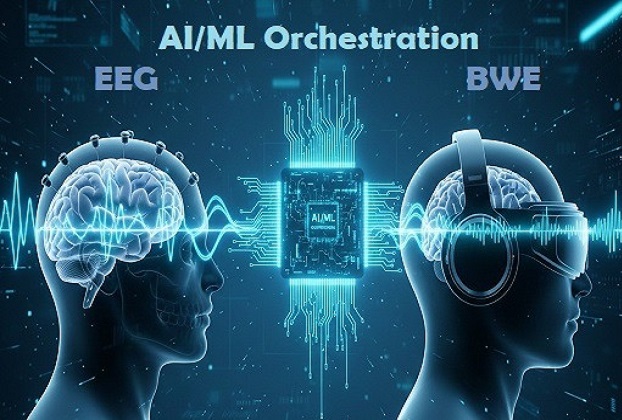
In this article, we refer to the EEG + BWE + ML/AI synergy as an AI-Orchestrated Brainwave Entrainment System — a closed-loop framework where real-time EEG (Electroencephalogram, a medical test that measures the electrical activity of the brain.) data is continuously analyzed by machine-learning models, which then orchestrate and optimize the exact entrainment frequencies, amplitudes, and timing patterns needed for the user’s evolving cognitive state. In other words, AI becomes the conductor, entrainment becomes the instrument, and the brain becomes the adaptive audience — creating a dynamic system capable of enhancing focus, calmness, creativity, and potentially a long-term cognitive performance.
Since we first explored the promise of brainwave entrainment (BWE) — how rhythmic beats and pulses can coax the brain into desired mental states — much of the attention has focused on the biological and phenomenological side: what happens in your head when you listen to binaural beats, or visually sync to a flickering light. In our earlier article on ITPrecinct, Brainwave Entrainment: Yet Undiscovered Panacea we unfolded the potential of BWE to uplift mood, sharpen focus, or induce deep relaxation. But today, I want to take you deeper — beyond the sensory experience, beyond subjective mood preparation, beyond simple biometrics. What if we treat BWE not just as a wellness “toy,” but as a data-rich input for building intelligent, and adaptive mental-wellness platforms?
In the hands of IT professionals, developers, data scientists, machine-learning engineers — BWE can evolve into a powerful substrate for personalization at scale. By and large, we may be moving from one-size-fits-all audio-visual protocols toward hyper-personalized, AI-driven entrainment system that learns, adapts, and optimizes itself in real time. Yes — thanks to the widely-accepted AI technology landscape.
The Untapped Potential of BWE-Derived EEG Data
In traditional digital health or wellness applications, personalization is often limited to simple biometrics or self-reported feedback. Think heart-rate variability (HRV), step counts, or “on a scale of 1–10, how anxious do you feel right now?” While useful, these are coarse, episodic, and heavily reliant on user compliance. In lieu of these coarse indicators, consumer-grade EEG devices — now increasingly common, inexpensive, and even bundled with BWE headsets — open up a vast, relatively untapped reservoir of personalized data streams that have a potential to be a part of an enormous achievement.
These devices generate time-series neural data: continuous streams of voltage fluctuations, sampled at frequent intervals, often capturing relative power in different frequency bands (Alpha, Beta, Theta, Delta). This data can record subtle, moment-to-moment shifts in cognitive state — not only mood swings, but transient micro-changes: the onset of distraction, a creeping anxiety, a sudden calmness, or a drop in alertness.
For IT professionals, this data is digital treasure. Properly processed, cleaned, and interpreted, EEG time series from BWE sessions can serve as the training ground for machine-learning models that learn how each individual’s brain reacts to various entrainment protocols.
From Raw EEG to Clean, Structured Data: The IT Challenge
But of course, harnessing EEG data isn’t as simple as plugging in and streaming raw logs. The IT challenge here is real — noise, artifacts, data volume, privacy, and transform pipelines all demand care… extreme care.
First: noise and artifact removal. EEG streams are notoriously noisy. Eye blinks, muscle tension, even subtle head movement produce artefacts. Without proper filtering — notch filters, band-pass filters, artifact detection, and removal algorithms. Those raw voltage streams can mislead downstream learning models. Then comes signal normalization, epoching (breaking continuous streams into windows), feature extraction (e.g., power spectral density in bands, coherence, event-related potentials), and labeling (linking a segment of EEG data with what happened — e.g., user pressed “start session,” user felt stressed, user felt thrilled etc.).
From a software-engineering perspective, building a robust data-processing pipeline resembles designing a real-world big data platform: ingestion, streaming, cleaning, transformation, storage, and versioning. For many BWE users the data may be generated locally — on the user’s device — but if the goal is to build powerful, ML-backed personalization, developers should consider cloud-based data ingestion or hybrid architectures. With time-series databases like InfluxDB, TimescaleDB or data lakes + object storage + efficient batch/streaming pipelines, e.g., using Apache Kafka, Spark, or cloud equivalents, scalability is achievable.
Moreover, as we build such pipelines, we must also architect for privacy and security. Brainwave data is deeply personal — arguably more intimate than heart rate or step count. Any wellness platform that aspires to store and process EEG streams must treat the data with the same rigor as regulated health data. Encryption at rest, end-to-end encryption during transport, user opt-in, clear privacy policies — they are much more significant than optional.
Only after we reliably transform raw EEG into clean, structured, labeled datasets can we feed them into ML/AI workflows.
Building the ML Pipeline: From Data To Personalized BWE Protocols
Once clean datasets are available, the journey toward personalization begins. Let’s walk through how a well-architected machine-learning pipeline might look for a BWE-powered mental wellness platform.
Feature Engineering
From EEG epochs we extract meaningful features: band powers (Alpha, Beta, Theta, Delta, maybe Gamma), ratio features (e.g., Beta/Alpha ratio — often associated with stress vs calmness), temporal features (how long a certain band remains elevated), and event-related features (how quickly a brainwave pattern shifts after a BWE session begins). Optionally, combine EEG features with contextual data; time of day, user activity (coding, designing, browsing, or other physical activities), computer usage logs, microphone/camera data (with consent), or even ambient-sensor data (light, noise, posture)
Labeling / Ground Truth Acquisition
For supervised learning, you need target labels. Some may come from user feedback (e.g., post-session self-report: “I feel relaxed,” “I feel focused.”), but as we aim to reduce user friction, you can start building labels from proxy indicators: reduced Beta wave activity, stable Alpha increase, duration of Alpha dominance, etc. Over time, as you build trust in your model, user feedback may become trivial. The model’s predictions and internal measures of “entrainment success” will attain the core value.
Model Training / Reinforcement Learning / Adaptive Optimization
Traditional supervised learning can help at first: e.g., correlate pre-session EEG features with post-session indicators of relaxation or focus, given a particular BWE protocol; frequency, duration, and intensity. But the real magic happens when you introduce reinforcement learning or adaptive algorithms: imagine a system that, after every session, updates its understanding of what works best for this particular brain. Each user develops a unique brainwave-pattern signature and hence a unique entrainment pattern is required, that is, a particular combination of frequencies, durations, and stimuli modes (sound alone, light + sound, etc.) that produce optimal results for them.
Over time, the system becomes more confident. Patterns emerge. It learns, for instance, “Whenever this user shows elevated Beta band activity around 3 PM with heavy computing activity… they respond best to a 12-minute 9 Hz Alpha-binaural track at moderate volume.”
Proactive, Autonomic Intervention
Eventually, you may not even need explicit user requests. The model, deployed in the background, monitors ongoing EEG (or periodically samples during work) and computer usage context. If it detects prolonged stress markers, it can gently, non-intrusively trigger a low-amplitude BWE session, perhaps via a subtle audio overlay or soft visual flicker. All this, without user initiation — a fully automated cognitive wellness companion.
Feedback Loop & Continuous Improvement
Over days, weeks, months — the platform refines itself. With enough data across many users, we may even begin to generalize: clustering entrainment signatures, identifying “types” of responders, and refining protocols for entire classes of users (e.g., “night-owl developers,” “anxious students,” “artists seeking flow”).
Why This Approach Matters — Especially For IT Professionals, Students, and Digital-First Minds
You might wonder: why should an IT geek, or a student majoring in computer science, care about all this? After all, BWE can sound somewhat “new age” But the truth is: the value lies in the data and in the software architecture.
Bridging Two Worlds
For those of us with a foot in software and a foot in human performance, this convergence — EEG, ML models, wellness apps — represents a powerful bridge. It’s a real-world problem that demands skills in data ingestion, signal processing, time-series modeling, privacy, UX design, and deployment.
Portfolio-worthy Projects
You could build a minimal viable BWE-driven ML platform and run it as a student or hobbyist project. Even if just for yourself, the data you gather can be used to prototype your own entrainment signature, or to explore how tough-working stress affects brainwaves. This project title has an immense potential to make you stand out from your peers in your institution.
Real-World Relevance
In high-stress, knowledge-work environments — as many of us in IT and in other professions are — mental wellness is not a luxury but a productivity-booster. A system that quietly helps manage mood, focus, and stress autonomously, can meaningfully enhance long-term cognitive health and daily performance.
Shape Future of Digital Health
How we choose to use emerging technologies and how we shape them — is perhaps the biggest opportunity humankind has bestowed upon itself. This is not about gimmicks; it’s about responsibly leveraging neuro-data, AI, and software to build scalable, impactful wellness solutions.
Technical Hurdles and Ethical Considerations — What We Need to Watch Out For
Of course, realizing this vision is not of little value. As with all things involving personal data and human biology, there are technical pitfalls and ethical minefields.
Signal Integrity & Calibration
As expected, EEG readings vary from person to person. Head shape, electrode placement, skin conductivity, ambient noise, and even hair all affect signal quality. Therefore, any serious system must include per-user calibration — ideally a short “baseline session” when the user is relaxed, alert, stressed — to build reference patterns before using BWE-based tuning.
Model Overfitting & Generalization
A reinforcement-learning model may become very good at optimizing for a specific user’s state — but may also overfit, failing to generalize, or produce weird behavior if the user’s life context changes, for instance, new job stress, different sleeping patterns etc. Handling such drift requires robust retraining, adaptive thresholds, and safety mechanisms like maximum daily BWE dosage, cooldown periods etc.
Privacy, Security, and Consent
As noted earlier, storing and processing EEG data is sensitive. If the platform is cloud-backed, you need strong data governance, encryption, user consent, data anonymization, and clear policies about data sharing. If the system triggers BWE sessions proactively, there should be clear user opt-in, ability to pause, and user control over when and how interventions occur.
Regulatory & Health-Safety Considerations
While BWE is relatively gentle compared to pharmacological interventions, repeated neural entrainment, especially unsupervised, is not yet as deeply studied as mainstream wellness methods. Applications must clearly inform users, possibly limit exposure, and encourage moderation.
Implementation Sketch — How Developers Could Actually Build It
Let’s briefly outline a potential architecture for a BWE-powered mental wellness platform for IT professionals or students:
Frontend / Client
It Runs on PC or mobile; integrates with a consumer EEG–BWE hardware (via SDK / Bluetooth / USB). It is supposed to stream raw EEG data to a local buffer for privacy, does light preprocessing on the client. It offers UI for optional mood logging, user feedback like “How do you feel after this session?” or “does the stress or discomfort vanish or reduce?”.
Backend / Data Pipeline
This layer uses streaming ingestion, e.g., WebSocket, MQTT. It Preprocesses microservices — filter, artifact removal, epoching, feature extraction. Provides Time-series storage (e.g., InfluxDB, TimescaleDB) or data-lake (e.g., Parquet on cloud storage). This is because regular database systems are not suitable for this sort of time-series data. It provides batch + online learning workflows. could use frameworks like scikit-learn, TensorFlow, PyTorch, or specialized time-series/sequence modeling libraries.
Model Layer
This layer could be Supervised models initially (classify pre-session state, predict optimal BWE settings). It will employ reinforcement learning agent, e.g, policy-gradient or bandit-based, to adapt protocols per user over time. It is supposed to maintain logging and evaluation — monitor usage, outcomes (EEG shifts), safety thresholds.
Integration & Automation
It hooks with OS-level context: when user begins tense job, faces tight deadlines, or long coding/QA sessions, trigger a “suggested break + BWE” pop-up or auto-run (with user consent). Provides dashboard / analytics for users: show trends, session history, mental-state graphs.
Privacy & Governance
- Local-first design: by default, store data on user’s device; cloud upload optional (opt-in).
- Encryption, anonymization, compliance with relevant data laws (GDPR-like frameworks).
- Transparency — users see what data is collected, how it’s used, ability to delete.
Even a prototype built on open-source EEG SDKs and simple ML models can deliver surprising value. For IT pros, developers and students — especially those familiar with cloud stacks, data engineering, or machine learning.
Can EEG + BWE + ML/AI synergy Enhance Cognitive Ability Substantially Beyond “Normal”?
While most discussions focus on BWE as a relaxation or focus-enhancement tool, the EEG + BWE + AI combo points to a deeper possibility: targeted cognitive amplification. Since specific brainwave bands are associated with memory encoding (Theta), analytical reasoning (Beta), creativity (Alpha–Theta transition), and problem-solving (Gamma), an adaptive entrainment system — guided by real-time EEG and optimized by AI — may be capable of repeatedly transforming the brain into states that naturally favor those abilities. Over time, this kind of consistent state conditioning could enhance neuroplasticity, potentially raising baseline cognitive function, not just temporary performance.
Machine learning plays the decisive role here. Static BWE has limited long-term impact, but AI-powered entrainment can analyze a user’s EEG response profile and continuously refine the stimulation pattern to maximize beneficial outcomes. For example, if the system detects improved retention during sessions where Theta bursts precede Alpha stabilization, it can intentionally recreate that sequence with precise timing. Reinforcement-learning agents can gradually learn “optimal” stimulation patterns that enhance encoding, recall, pattern recognition, or analytical switching. Early pilot studies in neurofeedback already show that individuals can significantly improve attention span, working memory, and learning speed when their brainwaves are trained toward certain states; an AI-driven entrainment system would automate and accelerate this optimization.
Does this arrangement move on to “augmenting the mind beyond natural baseline”? Potentially, yes. Cognitive enhancement through guided neurostimulation is not new, but combining BWE with EEG-informed ML accelerates and personalizes the effect dramatically. Whether this can push someone from “intelligent to genius” is still an open question, but theoretically plausible: if AI can reliably identify and reproduce a user’s most cognitively fertile brainwave configurations, and do so hundreds of times over months, it may lead to long-term improvements in neural efficiency. In other words, what caffeine does temporarily, AI-driven entrainment could someday do systematically, creating stable and prolonged improvements in memory, analysis, focus, and creative thinking… and that would be a marvelous service to the mankind.
Looking Ahead: What This Could Mean for Mental Wellness in the Digital Realm
Imagine a couple of years from now: a quality control engineer sits down at his desk in the afternoon. His mental state is a little foggy, due to late-night work. His workstation quietly senses elevated Beta activity. Without interrupting his flow, a subtle binaural beat in the background — tailored to his brain-waves entrainment signature — begins. Over the next 8 minutes, his brainwaves settle, focus sharpens, headache goes away, and he resumes his assigned tasks with clarity.
Then later, after a long QA session, subtle slow-flicker pulses coax him into Alpha/Theta, helping him unwind, avoid burnout, and clear mental clutter. Over months, the system learns when he needs stimulation vs relaxation. The system doesn’t wait for mood logs. It doesn’t annoy him. It simply works.
This is not science fiction. With current EEG-capable BWE hardware, open-source signal processing libraries, and mature ML frameworks, the foundation already exists. What remains is building the software signatures, data infrastructure, and intelligent models — the true core of a sustainable next-gen digital wellness platform.
For IT professionals, students, and digital-world geeks, this intersection — neuro-data meets software, provides a golden opportunity. By and large, we can go beyond mood-tracking apps and beyond simple biometric wellness tools. This is autonomic cognitive optimization: a hyperautomation of mental wellness, built on data, shaped by algorithms, and tailored to each individual brainwave profile.
At the end of the day, how we choose to use emerging technologies and how we shape them, is perhaps the biggest opportunity humankind has bestowed upon itself. If you’re an IT pro or a student reading this: take time to acquaint yourself with the underlying EEG data structures, build a small prototype, collect your own entrainment data — and see what you discover. You may well realize your potential, and perhaps build tools that help others realize theirs.
Global Developments & Achievements in EEG + BWE + AI Synergy
Over the past few years, we’ve witnessed remarkable global progress in the fusion of EEG analytics, brainwave entrainment, and machine learning. Consumer-grade EEG hardware has moved from niche research labs into mainstream accessibility. Companies like Muse, Flowtime, Emotiv, and NeuroCity are now offering affordable, SDK-supported EEG headsets designed explicitly for developers, opening the door to data-driven cognitive tools. Meanwhile, wellness and neurotech startups are beginning to integrate real-time entrainment into their digital offerings — from adaptive meditation apps to AI-powered focus tools that adjust soundscapes or frequencies based on the user’s neural patterns. Clinical institutions, too, are increasingly experimenting with BWE-driven interventions for anxiety reduction, cognitive rehabilitation, and sleep optimization.
On the AI side, the biggest leap has come from the application of sequence models (transformers adapted for time-series) to neural data. These models can detect micro-patterns in EEG signals that classical algorithms would miss. A growing number of research teams — particularly in the EU, US, and East Asia — are exploring how reinforcement learning can dynamically “steer” brainwave states by selecting optimal entrainment parameters in real time. Several published studies now report measurable improvements in attention, working memory, and emotional regulation using adaptive entrainment guided by ML predictions. While still early, this signals a shift from static BWE tracks toward AI-orchestrated neurostimulation tailored to each brain’s custom needs.
What’s especially encouraging is the ecosystem forming around open-source neurotech. We now have libraries for EEG preprocessing (MNE, MuseLSL, BrainFlow), AI-assisted adaptation (NeuroKit, Braindecode), and low-latency inference. These tools allow hobbyists, students, and independent developers to build sophisticated cognitive-enhancement platforms without requiring multi-million-dollar labs. In short, the groundwork has already been laid globally and the next breakthroughs will likely come from the intersection of accessible hardware, open-source ecosystems, and community-driven AI experimentation.