
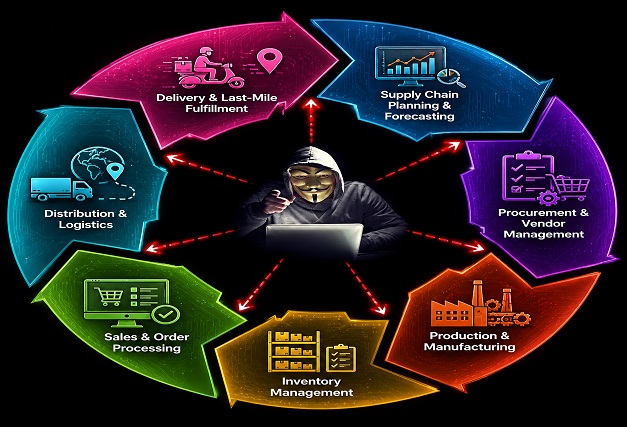
Introduction: The Cybersecurity Threat Most Organizations Never See Coming
When people think about cybersecurity attacks, they usually picture hackers breaking into company servers, stealing passwords, deploying ransomware, or spreading malware across corporate networks. While these threats certainly exist, modern cybercriminals have discovered something far more effective: attacking organizations indirectly through their digital supply chains.
In today’s interconnected world, businesses rarely operate in isolation. Instead, they function inside a vast digital ecosystem composed of software vendors, cloud providers, payment processors, logistics partners, customer relationship management platforms, open-source components, and countless third-party services. These interconnected systems constantly exchange information, often through Application Programming Interfaces (APIs).
The result is remarkable efficiency. Businesses can automate operations, improve customer experiences, and embrace hyperautomation at a scale that would have seemed impossible just a decade ago. However, this convenience comes at a price.
Every connection between systems creates another potential entry point for attackers.
A company may invest millions in securing its own infrastructure, only to be compromised through a vulnerable vendor, an exposed API endpoint, or a poorly secured third-party integration. In many cases, attackers don’t need to break down the front door when they can simply walk in through a trusted partner.
This growing threat landscape serves as a wake-up call for organizations of all sizes. To understand why supply chain exploitation via APIs has become one of the most significant cybersecurity concerns of our era, we must first understand what a supply chain actually is and how it has evolved in the digital age.
Understanding the Modern Supply Chain
The concept of a supply chain is not new. In fact, it dates back to the earliest forms of commerce and manufacturing.
Traditionally, a supply chain referred to the network of suppliers, manufacturers, distributors, warehouses, and retailers involved in producing and delivering a product to customers. A car manufacturer, for example, depends on dozens of suppliers that provide tires, engines, electronics, raw materials, and transportation services.
Using a simple analogy, imagine building a house. You need architects, contractors, electricians, plumbers, material suppliers, and inspectors. If one participant fails to deliver, the entire project suffers.
The same principle applies to modern technology.
Today’s organizations depend on numerous digital service providers. Consider a typical e-commerce company. Behind the scenes, it may rely on:
| Business Function | Supporting Service |
| Website Hosting | Cloude Provider |
| Payments | Payment Gateway |
| Customer Data | CRM Platform |
| Analytics | Data Service |
| Product Delivery | Logistics Provider |
| Email/SMS Marketing | Marketing Platform |
| Authentication | Identity Provider |
Collectively, these interconnected services, and many others, form a digital supply chain.
What truly sets modern supply chains apart from their traditional counterparts is the extensive use of APIs.
APIs: The Invisible Connectors of the Digital World
Before discussing API-related threats, let’s take a peek inside what APIs actually do.
API stands for Application Programming Interface. While the term may sound technical, the concept is relatively simple.
Imagine ordering food at a restaurant. You tell the waiter what you want, the waiter communicates with the kitchen, and the food is delivered back to your table. The waiter acts as an intermediary between you and the kitchen.
An API functions in much the same way.
One application sends a request through an API, another application processes the request, and the response is returned.
For example:
- A mobile banking application retrieves account balances through APIs.
- A weather app obtains forecast information through APIs.
- A shopping platform calculates shipping costs through courier APIs.
- Social media login features use APIs to authenticate users.
APIs have become the de facto mechanism for software communication for at least a couple of decades. They are instrumental in enabling organizations to integrate systems rapidly without rebuilding functionality from scratch.
Unfortunately, the same connectivity that makes APIs so useful also makes them attractive targets for hackers.
Why Cyber-Criminals Love Supply Chain Attacks
Cyber-criminals are constantly looking for the most efficient path to their objectives.
If a company is heavily protected, attackers may become skeptical about their chances of success through direct attacks. Instead, they look for weaker links in the broader ecosystem. This strategy is akin to targeting a supplier that serves hundreds or thousands of customers.
Why attack one company at a time when compromising a single vendor could potentially affect organizations to the tune of millions of users?
The logic is simple!
Attackers seek maximum impact with minimum effort.
A vulnerable software provider, exposed API, or compromised cloud service can become a highly lucrative target because it offers indirect access to numerous downstream organizations.
That’s just the tip of the iceberg. Modern supply chain attacks have evolved into highly sophisticated operations capable of causing widespread disruption across entire industries.
How Supply Chain Exploitation via APIs Works
The Trust Factor
Supply chain attacks often exploit trust rather than technology alone.
Organizations typically trust their suppliers, vendors, and integration partners. This trust allows systems to communicate freely through APIs. Ironically, that trust can become a weakness.
When a trusted vendor’s API is compromised, the attack traffic may appear entirely legitimate. Security systems often struggle to distinguish malicious activity from normal business communications.
This challenge gives rise to one of the most dangerous aspects of API-based attacks: invisibility.
Stolen API Credentials
Many APIs rely on API keys, access tokens, or authentication credentials.
Think of these credentials as digital passports. If attackers obtain them through phishing campaigns, exposed repositories, mis-configurations, or social engineering attacks, they can impersonate legitimate users or systems.
Since valid credentials are being used, security monitoring tools may not immediately detect suspicious activity. Attackers effectively blend into the background.
Exploiting Vulnerable Third-Party Integrations
Businesses frequently integrate with external services to improve productivity and keep up with real-world challenges.
Examples include:
- Payment processors
- Customer support platforms
- Shipping systems
- HR management tools
- Financial applications
- Credit Rating Systems
- Email & SMS service providers
Each integration creates a new trust relationship. Each trust relationship creates another attack surface. If a vendor exposes a vulnerable API endpoint, attackers may exploit it to gain unauthorized access to customer environments.
Excessive Permissions
Many APIs possess broad privileges. An API might access customer records, inventory databases, financial systems, employee information, or cloud resources. If such an API is compromised, attackers gain a significant advantage.
In some situations, excessive permissions can become the disastrous after an initial breach because they allow attackers to move laterally throughout interconnected systems.
Common API Vulnerabilities That Threaten Supply Chains
Broken Authentication
Authentication determines whether users are who they claim to be. Weak passwords, poorly implemented token management, and missing multi-factor authentication can create opportunities for attackers. Although this issue sounds trivial, it remains surprisingly common. Sometimes organizations focus on advanced security solutions while overlooking fundamental cyber hygiene practices.
Broken Authorization
Authentication confirms identity. Authorization determines what that identity can access. A user may be allowed to view their own customer record but not someone else’s.
When APIs fail to enforce proper authorization checks and provides much more access then required, attackers can manipulate requests to access unauthorized information. This vulnerability remains one of the most prevalent API security flaws worldwide.
Shadow APIs
Organizations often lose track of APIs over time. Developers create test environments, pilot integrations, temporary endpoints, and experimental services. Eventually, some are forgotten. These hidden APIs are commonly called shadow APIs.
Attackers actively probe networks looking for these overlooked assets. A forgotten API endpoint can provide attackers with an unexpected pathway into critical systems.
Data Exposure
Sometimes APIs reveal more information than intended.
For example, a mobile application might display only a customer’s name and recent orders. However, the API behind the application may also return addresses, account identifiers, internal notes, or payment metadata.
To a cybercriminal, such information represents valuable intelligence.
Even a small shred of knowledge can contribute to a larger attack strategy.
Lack of Rate Limiting
Without rate limiting, attackers can automate requests on a massive scale.
This enables activities such as:
* Credential stuffing * Account enumeration * Data scraping * Brute-force attacks
Organizations that fail to implement rate limits often discover the consequences only after suffering significant data exposure.
Threat Identification: Recognizing the Warning Signs
Threat identification is a critical component of supply chain security. Unfortunately, many organizations continue to fumble through security initiatives without fully understanding where their risks originate.
The process should begin with visibility. You cannot protect what you cannot see.
Security teams must identify Internal APIs, External APIs, Vendor APIs, Legacy integrations, Cloud-based APIs, and Third-party dependencies. Only after building a comprehensive inventory can organizations begin assessing risk effectively.
Monitoring the Digital Footprint
Every organization leaves a digital footprint.
This footprint includes public-facing applications, cloud services, websites, APIs, and external integrations.
Attackers routinely map these footprints before launching attacks.
Organizations should do the same.
Regular assessments can uncover exposed endpoints, forgotten assets, and unnecessary integrations before attackers discover them.
Behavioral Analysis
Traditional security tools focus heavily on signatures and known threats.
Modern API attacks often bypass such controls.
Behavioral analysis helps organizations detect unusual activities, including:
* Unexpected traffic patterns * Large-scale data transfers * Access from unusual locations * Unusual API request volumes
These indicators may signal a developing compromise.
Real-World Supply Chain Attacks and Their Lessons
Several high-profile incidents have demonstrated the devastating impact of supply chain attacks.
The SolarWinds incident is perhaps one of the most vivid examples.
Attackers compromised software updates distributed by a trusted vendor. Thousands of organizations installed the updates believing them to be legitimate.
The consequences cast a shadow over the entire technology industry.
It underscored the importance of examining trust relationships more carefully.
The lesson was clear:
Trust should never replace verification.
Similarly, numerous cloud and SaaS breaches have highlighted how vulnerable APIs can become gateways into broader business ecosystems.
In retrospect, many of these incidents reveal warning signs that were overlooked or underestimated.
Why Mid-Sized Organizations Are Particularly Vulnerable
Many people assume that only multinational corporations face sophisticated cyber threats.
Reality tells a different story.
Mid-sized businesses frequently find themselves stuck in a corner.
They possess valuable data and extensive third-party integrations but often lack the resources available to large enterprises.
As a result, attackers view them as attractive targets.
These organizations commonly struggle with:
* Limited cybersecurity budgets * Smaller security teams * Legacy infrastructure * Incomplete asset inventories * Insufficient API governance
The combination creates opportunities for adversaries seeking easier paths into larger supply chains.
The Rise of Cloud Computing and Hyperautomation
Cloud computing has accelerated API adoption dramatically.
Nearly every modern cloud service relies heavily on APIs.
Storage systems, virtual machines, identity management platforms, analytics services, and AI tools communicate continuously through API calls.
At the same time, businesses are embracing hyper-automation to streamline operations.
Processes that once required human intervention now occur automatically.
Orders are processed automatically.
Invoices are generated automatically.
Inventory levels are updated automatically.
Customer notifications are sent automatically.
While this automation delivers substantial benefits, it also increases dependency on APIs.
The more APIs an organization uses, the larger its attack surface becomes.
Addressing Supply Chain API Security Risks
A common misconception is that organizations simply need a single security product to solve the problem.
There is no silver bullet.
Effective supply chain security requires a multi-pronged practice involving technology, processes, governance, and human awareness.
Let us expand on that.
API Discovery and Inventory Management
Organizations should maintain a complete inventory of APIs.
This inventory should include:
* Purpose * Ownership * Authentication methods * Permissions * Associated vendors * Data classifications
Visibility remains the foundation of security.
Strong Authentication Controls
API authentication should be treated with the same seriousness as user authentication.
Best practices include:
* Multi-factor authentication * Secure token management * Short-lived credentials * OAuth implementations * Certificate-based authentication
These measures significantly reduce unauthorized access risks.
Principle of Least Privilege
APIs should receive only the permissions required to perform their intended functions.
Excessive permissions increase potential damage following a compromise.
If attackers gain access, restricted privileges help contain the incident.
Continuous Security Monitoring
Security monitoring should extend beyond traditional networks.
Organizations should monitor:
API traffic
Vendor communications
Authentication events
Data access patterns
Configuration changes
Continuous monitoring helps organizations stay ahead of the curve rather than reacting after damage occurs.
Vendor Risk Assessments
Third-party vendors play a crucial role in supply chain security. Organizations should evaluate vendors carefully before integration.
Questions worth asking include:
How are APIs secured?
What authentication methods are used?
Are security audits performed regularly?
What incident response procedures exist?
Security responsibilities must be shared across the supply chain.
Employee Awareness and Cyber Hygiene
Technology alone cannot solve security problems. Human behavior remains a critical factor.
The stake-holders should understand Phishing risks, Credential protection, Secure development practices, Data handling procedures, Vendor security considerations. Strong cyber hygiene often prevents incidents that sophisticated technologies fail to stop.
Looking Ahead: The Future of Supply Chain Security
The future of cybersecurity will increasingly revolve around ecosystems rather than individual organizations. As digital transformation accelerates, organizations will become even more interconnected. Artificial intelligence, cloud-native applications, Internet of Things devices, and automated business workflows will continue expanding API usage.
This trend is unlikely to slow down. Consequently, supply chain exploitation through APIs will remain a major concern for the businesses and IT Teams. Some security threats may even appear out of the blue as attackers discover novel ways to exploit interconnected systems.
Others may initially seem over-hyped but later prove far more serious than anticipated. The challenge facing modern organizations is therefore not merely protecting individual assets but securing entire chains of trust.
Conclusion
Supply chain exploitation via APIs represents one of the most important cybersecurity challenges of the modern era.
At its core, the issue boils down to interconnectedness. Businesses increasingly depend on complex digital ecosystems composed of vendors, cloud services, software platforms, and automated integrations. APIs serve as the connective tissue that enables these relationships to function efficiently.
Yet the very mechanism that enables innovation also creates risk. Attackers understand that compromising a trusted supplier or vulnerable API can provide access to numerous organizations simultaneously. Whether by hook or by crook, cybercriminals continuously search for weak links that allow them to bypass traditional defenses. The challenge is undoubtedly a tough nut to crack. However, organizations are not powerless.
Through comprehensive API visibility, strong authentication, continuous monitoring, vendor risk management, employee education, and disciplined cyber hygiene, businesses can significantly reduce their exposure.
Supply chain security is no longer a niche concern reserved for cybersecurity experts. It affects developers, IT managers, business leaders, system administrators, and technology enthusiasts alike. Understanding these risks today may ultimately be what separates resilient organizations from those that become tomorrow’s headlines.
And if recent cyber incidents have taught us anything, it is that securing APIs is not merely a technical exercise—it is a business imperative that underscores the importance of protecting trust itself.
You may also be interested in reading these articles:
VirusTotal: A Mighty All-in-One Solution for Malware Detection
New-Age Cyber Attacks: How Hackers Trick Humans, Not Just Systems